



Infobox:
Interested in volunteering? Hospice of Southern Maine offers a 40-hour fall training class that starts Oct. 19 and runs for four weeks. Call 289-3652 for more information.
Richard Berman of Cape Elizabeth often gets the same reaction from people when he tells them he volunteers for hospice.
“It’s common for someone to say, ‘Oh, I couldn’t do that. It would be too depressing,'” said Berman, who has helped dying patients and their families for 25 years.
But Berman’s experience is just the opposite. “It has been powerful and uplifting to serve as a hospice volunteer. It is the closest I ever get to God,” he said.
The recent opening of Gosnell Memorial Hospice House in Scarborough adds another layer of end-of-life care for terminally ill patients in Cumberland and York counties.
Hospice of Southern Maine, a nonprofit agency, already provides 2,500 hours of volunteer care to patients in the community each year. The new hospice house, which it oversees, offers in-patient treatment for people too sick to live at home.
But with the expanded care comes a greater need for volunteers, who are at the heart of the hospice mission.
Volunteers offer a compassionate presence to patients and their loved ones. They often spend more time with a patient than the rest of the hospice team, composed of health-care workers, a social worker and chaplain.
“Volunteers come without an agenda,” said Eileen Chretien, volunteer coordinator. “They are there for quiet, loving companionship and caring.”
Hospice of Southern Maine has 150 volunteers who visit and offer comfort to terminally ill patients. Here’s a quick look at their vital role:
• Volutneers go into homes, nursing homes, hospitals, assisted living facilities and the hospice house in Scarborough.
• They are active listeners offering emotional support to patients and families.
• Volunteers read to patients, write letters and finish projects for them.
• They help with errands and provide respite for care givers.
“Volunteering often is about listening and being there,” said Berman. “Just being present and hearing can be very healing to people.”
Berman describes volunteers as coming from a “complete place of love” by offering, as Mother Teresa said, an open heart and willing hands.
“When someone lets you into their life at this time, it is sacred space and it is very real,” Berman says. “It offers some powerful spiritual lessons.”
Berman has encountered dying patients alone and without loved ones to support them.
“I remember so well the first case I got as a volunteer. This man was homeless and deaf,” said Berman. “There was no one there for him at the hospital, and I showed up. I would write notes to him, and he would write back. Just being there made a difference.”
Dealing with loss
Berman knows the pain of losing a loved one and the need to show compassion to dying patients and their families.
Berman’s daughter died of leukemia when she was 6 years old. The experience led him to hospice. “When she was dying, it was a lot of stress, and I took yoga at Williston West church,” he said.
It was during a class that Berman spotted the office of what was then called Hospice of Maine, located on the church’s second floor.
“I suppose I was led to it,” Berman said. “It was a very small organization back then and one of the first in the U.S. I joined and eventually trained to be a volunteer.”
More than two decades later, Berman continues to volunteer with enthusiasm. He served on the facilities board when the new Gosnell Memorial Hospice House was designed and built. He also sits on the Hospice of Maine Foundation board.
Berman is so committed to the hospice philosophy of comforting and caring for the terminally ill that he encouraged both his parents to use the services before they passed away. “My mom and dad lived in Florida, and at the appropriate time they connected with hospice,” he said.
The goal of hospice is not to cure or rehabilitate. Through hospice, terminally ill patients get the emotional, physical and spiritual support they need to manage symptoms, find comfort and die with dignity.
Berman and other hospice workers say it is a privilege to work with dying people. The experiences help them put their own lives into perspective.
“For someone to share this intimate time of life is very special,” said Berman. “When I’m grieving with someone, it feels as though God is not far away.”
Volunteer Le Silkey of South Portland added, “There is great joy and strength in volunteering with hospice.”
Like many volunteers, she was drawn to hospice after a close family member died. Silkey’s sister did not receive hospice care and died in a hospital. But the nurses showed compassion that helped her through those final hours.
“I thought at the time, ‘That is what I want to do,”‘ said Silkey.
Silkey trained as a hospice volunteer after moving to Maine three years ago from Washington, D.C.
“Volunteering for hospice strengthens spirit and character,” said Silkey. “I can deal with other aspects of my life with considerable honesty.”
Becoming a volunteer
Volunteering takes dedication and commitment, but the rewards are tremendous, say veteran volunteers.
Forty hours of training and ongoing education are required. Volunteers learn about the hospice concept and explore individual views and beliefs on dying.
Chretien, the volunteer coordinator, works to match patients with volunteers. The volunteer is expected to commit to at least two to four hours per week after being assigned a case.
Volunteers are not substitute health care workers. They do not give medicine, nor do they bathe or lift patients.
Although the hospice house is working to build its pool of volunteers, every new volunteer starts in the community to understand firsthand the hospice mission. “Hospice foremost is about people being able to stay in their homes during their end of life journey,” said Chretien.
After six months, volunteers may be assigned to the hospice house, where patients stay briefly or spend their final weeks of life.
Whether in the community or at the hospice house, the volunteer is essential in carrying out the hospice mission.
“Sometimes folks offer to volunteer because they have had a good death or hospice experience,” said Chretien.
“Others come to us out of the goodness of their hearts. Hospice speaks to them, and they answer: ‘What can I do?”‘
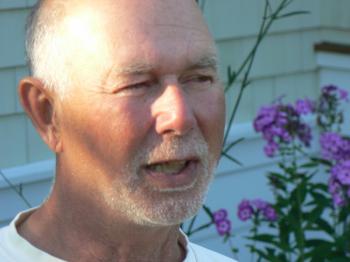 Richard Berman, a hospice volunteer, remembers his first patient, a man who was homeless and deaf.
Send questions/comments to the editors.
