



Tyler Dunphy’s Blackberry buzzes five or six times in the course of a half hour as e-mail after e-mail finds its way to the Westbrook technology director’s pocket.
Meanwhile, in another part of the school, Jim Garner, the high school tech guru (not an official title), is installing a Smart Board in a classroom for senior English and public speaking teacher Margaret Hewes. This will be the first year she gets to use the device, and she’s not a new teacher.
“I don’t know how I could have taught without this,” a clearly excited Hewes said. “If you put something on a screen, the students’ eyes are glued to it.”
While the state lacks any concrete data on the effectiveness of technology in the classroom, most schools are moving forward in some way to add more of it, while also gathering anecdotal evidence to show the additions are beneficial. The Westbrook school system this year is moving forward on increasing its ability to run more computers at faster paces, developing online classrooms through the open-source Moodle software, and adding a Smart Board to Hewe’s classroom, who is the lucky recipient based on her proposal of how she would use it.
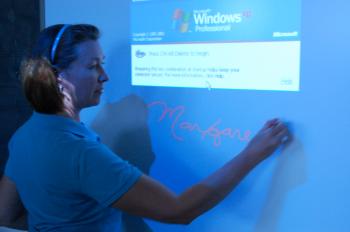
Dunphy doesn’t miss a beat chatting about the Smart Board as the e-mails buzz in his pocket. The board functions as an interactive white board, where teachers can browse the Internet and multimedia, edit a student’s paper or write class lessons to be erased with the click of a button. White-board markers have been surpassed by technology, like chalk was not so long ago.
For the staff, said Dunphy, “their basic ability to integrate (technology) is phenomenal.”
Hewes will take a little time to learn the ins and outs of the Smart Board, but the possibilities are grand. Hewes could, if she wanted, virtually fly to Westbrook through Google Earth on an English assignment, where students would find, “To Martha S. Gould, Westbrook, Maine, 9th mo., 5th, 1845. My dear Martha: I wrote from the house of Timothy Varney, of Kennebunk; and the next evening received thy note, at the house of J.H., in the town of Gorham,” written by Thomas B. Gould in a book of his letters published over seven score ago in print, more recently online, and geolocated in Westbrook in Google Earth.
Hewes could operate a computer at a desk or a book at a podium. But the Smart Board allows her to stand in the front of the class and access the controls via the board itself, interacting with both students and course materials on the screen.
“Many things today with technology are somewhat flashy so it creates attention,” said Jeff Mao, the Maine Department of Education’s coordinator of educational technology. “But it really comes down to how the teacher uses it.”
Even with the general sense of success with the Maine Learning Technology Initiative, which deployed laptops to all seventh- and eighth-grade students five years ago, the stakes remain high.
“People want quantifiable results. They rarely get them,” Mao said. He said it’s not so easy to perform a scientific study where some students are given a placebo education without technology, and others a real education with technology, and then judge the results. David Silvernail of the University of Southern Maine is expected to publish some of the most concrete data to date later this year, but for now the state must wait.
According to Mao, some of the more successful teachers are those comfortable with making change, and who are able to adapt to new ways of providing course material.
This year the state is launching a new program that will deploy laptops to every high school teacher and administrator, which is expected to bring even the mildly interested or talented into the fold, and will enable educators to interact with each other all over the state outside of conferences and seminars.
But even for a savvy techie like Dunphy, the hour still comes when he receives a phone call and asks, “Can I borrow your pen?”
He writes a phone number, in blue ink, on his hand.
 Technology: Effectiveness in hands of teachers
Send questions/comments to the editors.
