



An Afghani fixer named Javed finding work building steel playgrounds for his country’s orphans might not sound like the outcome of a local microbiology researcher going “adventure bicycling” during the 1991 coup in Haiti. But that’s the story of Scarborough resident, Westbrook businessman and global photographer Charles Carpenter.
Carpenter, 57, whose large-format photographs are on display at the University of Southern Maine’s Glickman Family Library, is a Grand Rapids, Mich., native who has been living in Scarborough since 1991, when he took a position as a researcher in Westbrook at Idexx. He also runs the two-year-old Historic Map Works on Spring Street in Westbrook, where he is developing a four-dimensional, interactive map and genealogy tool using rare cadastral maps showing land ownership in the 19th and early 20th centuries U.S.
That’s only a little bit of what he does. Perhaps most important of his varied experiences is the International Childhood Enrichment Program, the nonprofit foundation that is helping to build playgrounds for children in not only Afghanistan, but also Haiti.
Carpenter is displaying his photographs at the Glickman library, in a show titled “Portraits from the Edge of the World,” as a fundraiser for that foundation. The photographs, as well as a number of donated goods (from Pavilion Box tickets to Red Sox games to karate lessons to boat trips and luncheons), will be auctioned Saturday amid live jazz and a free buffet. All proceeds from the auction – save the cost of the event itself – go toward new playgrounds, which are built using local materials and labor in Afghanistan and Haiti.
Carpenter said the foundation, which was incorporated in 2003 and is run by volunteers, has built a half-dozen playgrounds in each country, at around $2,000 apiece. He has raised about $40,000 over the last few years.
“We want to bump that up to six figures,” Carpenter said. A six-figure playground fund stems from Carpenter’s feeling that “the best time to visit a war-torn country is right after it happens.”
Carpenter’s journey to create the foundation spans several continents, numerous countries, a stint in the Air Force as a photographer, and with bicycling and sailing hobbies thrown in for good measure.
Born in 1950, Carpenter spent four years in the Air Force, joining when he was 20. He earned his bachelor’s degree from the University of Alaska in 1976, and his doctorate in microbiology from the University of Texas at Austin in 1979. He moved to Scarborough in 1991 after securing a position at Idexx. That was also the first year he traveled to Haiti.
“A couple of guys wanted to go bicycle touring,” Carpenter said, so he suggested Haiti while the coup to oust Jean-Bertrand Aristide was in progress. All but one other person dropped out of the trip.
“We showed up in Haiti literally in the midst of a coup,” Carpenter said. He was carrying 60 pounds of camera equipment on his bicycle. “People said we were nuts.”
While in Haiti the first time, Carpenter took a photo that has stayed in his head on every subsequent trip he’s taken around the world. On display at the Glickman library, it’s a portrait of three naked Haitian children standing in front of a jerry-built toy truck of scrap material. The photo description said the father of the children came up after the photograph was shot and broke up the scene, taking away the toy truck, embarrassed by the poverty of the family’s situation.
Carpenter wasn’t sure where his trips or photography was headed at that point. “We went (to Haiti) strictly as an adventure,” he said. But still he kept that photograph in the back of his mind.
After his return, he gave talks around Portland and Westbrook, including at the Walker Memorial Library, about adventure bicycling. He decided to visit Haiti again in 1994, after Aristide was back in power and while U.S. troops were present. He took more photographs, one of three U.S. Army sergeants, well-groomed and well-equipped, looking like a Hollywood show in contrast to the three children he had photographed three years earlier.
Returning to Maine once again, and continuing to look for adventure, Carpenter built a sailboat. He had never sailed before, nor had he ever built a boat. But two years later, the vessel was finished, and off he went.
“You learn sailing pretty fast when you head out into the ocean,” Carpenter said. He sailed around the Atlantic, up to Halifax, Nova Scotia, and down to Bermuda, Cuba and Haiti for his third visit.
On Sept. 11, 2001, Carpenter was in New York City with a video camera, and captured footage of the terrorist attacks that morning. Five months later, Carpenter was off to Afghanistan.
“While (in Afghanistan), I decided to do the foundation. I didn’t know what we would do, but knew we would do something,” Carpenter said, still keeping the photo of the three Haitian children with the toy truck in mind.
Shortly after his trip to Afghanistan, Carpenter began his work with Javed, his Afghani translator and transporter, building playgrounds for orphans. The foundation coordinates with Javed and his Haitian counterpart on the construction.
“Anything else – medical, mine removal – there are dozens of international organizations doing that,” Carpenter said. There was nothing like the playgrounds he was building around Afghanistan.
“It wasn’t uncommon to have 400 kids on the playground,” he said.
Since then, Carpenter traveled to Somalia in 2003, where he gained entry on the day of the U.S. invasion of Iraq, when all American reporters and photojournalists were leaving the country. He arrived aboard an old Russian bomber filled with khat, the local plant chewed as a drug. With problems getting out of the airport and into the country, Carpenter managed to get picked up in a discarded U.N. jeep by a candidate for the Somali presidency through Somali contacts Carpenter had made in Portland. In 2004, Carpenter used his American contacts to find a fixer in Liberia, who turned out to be the country’s most famous soccer star. That gave him unrestricted access to much of Monrovia.
“It was like walking around Harlem with Michael Jordan,” Carpenter said.
All along, Carpenter has been photographing the war-torn places he has visited. With what started off as an adventure bicycling trip of a microbiology researcher has since turned into a dedicated and growing foundation to build recreational opportunities for children in inhospitable places.
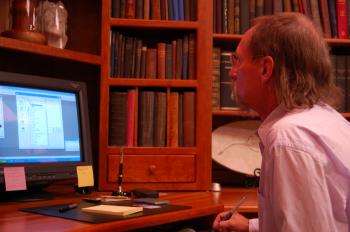 Charles Carpenter at his desk at Historic Map Works, his Westbrook company that provides historic map services and products. Carpenter’s photographs from war-torn countries are on display the the Glickman Family Library in Portland, with an auction on Saturday to benefit a foundation that builds playgrounds in Haiti and Afghanistan.
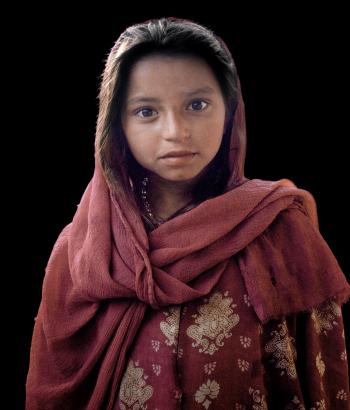 “Girl in red scarf,” Afghanistan, is one of the photos on display as part of a benefit for Charles Carpenter’s International Childhood Enrichment Program, a nonprofit that builds playgrounds for orphans in Afghanistan and Haiti.
Send questions/comments to the editors.
