



In 1991, Meg Wolff’s left leg was amputated due to bone cancer, and the mainstream treatment her doctor recommended came with uncomfortable side effects. In 1998 Wolff was diagnosed with invasive stage 3B breast cancer.
Her doctor recommended a bone marrow transplant. She went for a second opinion and was told the same thing. When she asked an alternative medicine practitioner, someone who practices medicine not supported by the science-based medical community, she was told a macrobiotic diet could help her body fight the cancer.
“I thought it was wonderful and I believed it,” said Wolff, a Cape Elizabeth resident.
Wolff was a guest at the Windham Public Library Monday, speaking in connection with her book, “Becoming Whole,” published in November, which details her battle with cancer and the often controversial diet she adopted to fight it.
Wolff was eager to try the macrobiotic diet. She had read about it years before and was intrigued, and started taking cooking classes with Maine guru and chef Lisa Silverman.
Taking it’s name from the Greek words “macro” for large or long and “bios” for life, the macrobiotic diet excludes meats, dairy products, fruit, coffee and sugar. The diet includes whole cereals, vegetables, beans, nut, legumes and seaweed. It may or may not include fish, depending on individual taste.
Wolff underwent chemotherapy and radiation treatment while she practiced the macrobiotic diet. She said her weight dropped to 113 pounds and she started eating more oil to gain weight. Wolff said her doctors mistakenly predicted the cancer would return within a year.
Wolff said she’s been cancer free ever since, and she feels it was the macrobiotic diet and not the chemotherapy and radiation treatment that cured her.
She said different foods fall into different places on a “yin” and “yang” spectrum, with sugars and meats on the yin side and salts and red wine on the yang end. Wolff said the body needs to have its yin balanced with its yang, and the easiest way is to eat plant-based foods that are in the middle of the spectrum.
“I’m not really scientifically based,” said Wolff. “Macrobiotics is about the energy of the food.”
“I hate to call it a diet because to me, it’s really a lifestyle,” said Connie Arnold of Lyman, who was diagnosed with aggressive lymphoma in June 2004 and chose a macrobiotic diet instead of conventional medicine for treatment. She describes herself as “an old-fashioned grandmother.”
“I believe the food we put in our mouths can control our wellness or our illness,” she said. Arnold said her evaluation with a macrobiotic counselor involved looking at the shape of her face, hands and feet to see what foods she needed.
Arnold, who has eight children and 18 grandchildren, said her family was initially against her decision, but when her cancer went away they changed their tune. She is training to become a macrobiotic counselor.
“I’m not saying we don’t need doctors, we definitely do need them,” said Arnold. She said her doctor was against her choice not to take conventional treatment, but was still supportive.
“He told me, I will always be here for you,” she said.
The medical community, however, does not promote the diet as a cancer cure.
“I hate to call it a treatment choice, it’s really not that,” said Peggy Belanger, the cancer care program manager at Southern Maine Medical Center in Biddeford. The program offers macrobiotic cooking classes.
“What SMMC does is that it supports all manners of treatment,” said Belanger. “To say that it endorses it, no, but it supports all opportunities of education so people can make an informed decision.”
She said the macrobiotic diet has some health benefits, such as reducing the risk of cardiovascular problems, but said she can’t say it helps fight cancer.
“There’s been no randomized clinical studies that support that,” she said.
“I know some other people (with cancer) who chose macrobiotics and died,” said Belanger, adding that she doesn’t know if chemotherapy or radiation treatment would have saved them.
“It’s definitely their choice,” she said. “And my role would be to make sure they have as much information as they can.”
According to a pamphlet on alternative medicine from the National Cancer Institutes, the government’s prinicpal agency on cancer, “It’s important to know that there is no one food or special diet that has been proven to control cancer.”
“We don’t use the word ‘cure’ ourselves,” said Mirea Ellis, director of public relations for the Massachusetts-based Kushi Institute, where many of Wolff’s concepts come from. She and Wolff both said there are no statistics that show the success rate of cancer patients who try a macrobiotic diet.
“People come here and they are really scared, because they’ve been told they’re going to die,” said Ellis. She said Michio Kushi started the education center in 1978 and about a thousand people come there each year.
She said the institute doesn’t have enough money to study the health benefits of the macrobiotic diet.
“Many of these people, unlike Meg Wolff, go off the diet and their cancer comes back,” she added, saying it’s difficult to know how many people stick with the diet.
At Maine Medical Center in Portland, Dr. Craig Schneider, director of integrative medicine, said his department provides patients with information on both conventional and alternative medicine and helps them make an informed decision on what treatment they want.
As for the macrobiotic diet, he said he doesn’t know a lot about it.
“It’s a healthy diet for a lot of people who are trying to avoid some chronic illnesses,” he said. “As a sole treatment, no one has proven it’s effective against cancer.”
He said people who follow it need to be careful to avoid becoming deficient in B12, calcium, iron and riboflavin.
Alice Cash, 55, of Windham lost a sister to breast cancer and was in attendance at the Windham Public Library on Monday for Wolff’s book tour.
“I thought it was very interesting and scary,” she said. She said she doesn’t plan to start a macrobiotic diet because she doesn’t want to give up all the foods she loves.
Wolff, however, remains dedicated to the idea.
“I don’t have a scientific background, I can only tell you what I did and what I ate,” she said.
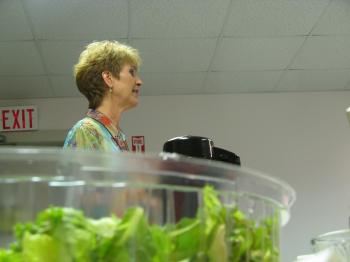 MegWolff1: New age diet practitioner and author Meg Wolff speaks in the Windham Public Library about the plant-based diet she believes cures cancer.
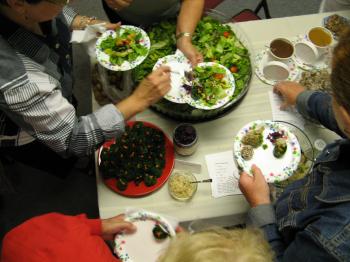 MegWolff2: The macrobiotic diet includes whole cereals, vegetables, beans, nut, legumes and seaweed, but no animal products, including milk.
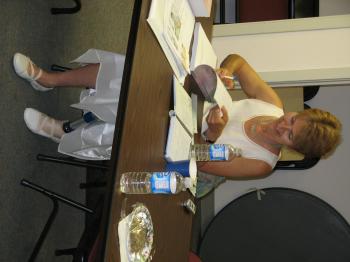 MegWolff3: New age diet practitioner and author Meg Wolff signs a copy of her book, “Becoming Whole,” at the Windham Public Library. It details the story of her cancer battle and the plant-based diet she believes healed her.
Send questions/comments to the editors.
