



Westbrook voters will be asked Tuesday to approve borrowing $29.4 million for a new middle school and $4.1 million for a new auditorium.
If voters approve borrowing the $29.4 million, the state would pay $26 million toward construction of the school, to be built off Stroudwater Street. It would replace the city’s junior high school on Bridge Street, which educators say is a poor environment for teaching. Because the new building is designed to be energy efficient, the Maine Public Utilities Commission would also contribute $120,000 to the project.
Westbrook residents would pay $3.5 million of the cost of the new middle school and the total $4.1 million cost of the 1,000-seat auditorium. The $3.5 million would pay for portions of the school the state will not pay for, such as increased cafeteria and gym sizes.
The $3.5 million also does not include approximately $1.7 million in interest on the bond. The $4.1 million cost of the auditorium does not include $2 million in interest.
The school bond would increase the tax rate by 27 cents per $1,000 of valuation, a $37.80 a year tax increase on the average $140,000 home. The auditorium bond would increase the tax rate by 31 cents per $1,000 of valuation, an increase of $43.79 on the average $140,000 home. If the two projects pass together, the tax rate increase would be 58 cents per $1,000, or $81.59 on the average home.
City Councilor Suzanne Joyce, who also sits on the project’s building committee, said the plan has received “great support,” and that she can’t keep up with the number of citizen requests for the red and white signs supporting the project.
“We are obviously going to have to do something with the existing building,” even if the referendum doesn’t pass and the city doesn’t get the $26 million the state is offering, Joyce said.
Brian Mazjanis, the principal at Wescott Junior High School, said there is a “ton of life” left in the building, and that educators at the school are doing great things in spite of its deficiencies, but overall the building is simply not conducive for teaching.
“Natural light is essential,” Mazjanis said, pointing out that some classrooms exist in a “cave” cut out of large open spaces. He described the classrooms as “ridiculous,” with no windows and poor ventilation. Mazjanis also said the walls that don’t reach the ceiling allow significant noise from the hallways and classrooms to spill into other classes, making teaching difficult and compromising student concentration.
About 50 percent of the students must exit the main building for classes in modular buildings, Mazjanis said. The modular buildings are in various states of disrepair, with one classroom wall meeting the floor with the assistance of duct tape.
Mazjanis said the proposed school to be voted on Tuesday is “very trim,” and doesn’t include any extravagances.
“We dreamed,” said Mazjanis, “but in the process we cut a ton of things from that original list of things we wanted.”
The new building is designed so classrooms can form “learning communities,” or small teams of multiple classes, to allow interdisciplinary collaboration. There is a common room on each floor that could hold 80 students or more for teachers to hold joint classes, host guest speakers or make large-group presentations. The building is also designed to allow for easy expansion if the need arises, with a reinforced structure for additional space on a first-floor roof.
Mazjanis said the new auditorium wouldn’t be specifically for the middle school, but would be used by all the schools and the broader community. Mazjanis said the high school auditorium is a sweat box with a tiny stage that does not allow the school system to showcase performance art shows with any.
But the multi-million dollar bonding for a school is a sore spot for some Westbrook voters.
“It’s not for education. It’s for a building,” said Lori Hawkes, who plans to vote against the referendum. Hawkes admitted the current junior high “looks disgusting,” but argued it could be fixed. She said she wouldn’t care if her child – who is currently in high school – was taught in a one-room school building, as long as the education he received was of a higher caliber.
“We’re not putting out rocket scientists from Westbrook,” Hawkes said, noting the high school’s test scores are “always below average.”
Orleans Jeffers, a longtime resident across from the former DeWolfe property, where the new junior high is proposed to be built, said the move simply doesn’t make sense.
“Your taxes are going to go up again, and we don’t need that,” Jeffers said. She is concerned that, in addition to the costs of the new building, the old building will continue to put financial pressure on the city.
Due to high energy-efficiency standards, the Maine Public Utilities Commission would contribute $120,000 to the project. The building would have a geothermal heating and cooling system, and engineering would direct natural light into classrooms for light and heat. The full climate control design is estimated to save $90,000 a year in operational costs even though the current building does not have air conditioning.
For Mazjanis, the bonding is a no-brainer. He said the local share of the project could be thrown into the existing building, but the renovations wouldn’t even be visible. The money the state would contribute to the project will not go back to taxpayers if the referendum is rejected.
The money “will go to build another building in the state,” Mazjanis said. “If we don’t take it, someone else does.”
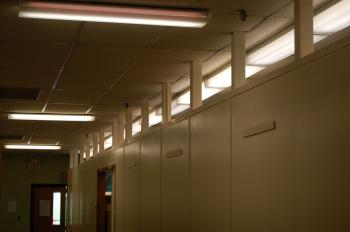 The three-quarter walls at Wescott Junior High in Westbrook aren’t conducive to teaching, said principal Brian Mazjanis. The walls can’t be brought all the way to the ceiling unless new ventilation and sprinkler systems are installed, but to do so would still leave the classrooms devoid of natural light.
 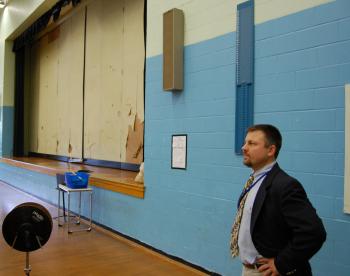 Wescott Junior High Principal Brian Mazjanis looks across the school’s performance art center. Mazjanis said the space is not appropriate for showcasing the quality of art the school can offer.
 A rendering of the proposed middle school for Westbrook. Voters will go to the polls on Tuesday to vote on a referendum question regarding the school project.
Send questions/comments to the editors.
