



First Music Sunday
The May 6 service at the Unitarian Universalist Church in Westbrook was its first Music Sunday service, from 10:30 to noon. I had seen Dan Glover recently and he mentioned the program to me. I was pleased that I could be there.
Brian Morrison was the moderator and Dan Glover also spoke.
The Magnificent Sanctuary Band’s first number included vocals by Nigel Hall, Earl Presnell and Sara Therrien. Members of the group are Nigel Hall, keyboards and vocals; Dominic Lavoie, guitar and vocals; Tony McNaboe, drums and vocals; Jon Roods, bass guitar; and Kari Presnell and Sara Therrien, vocals. Among the well-known musical numbers were “I Shall Be Released,” by Bob Dylan, and Stevie Wonder’s “If It’s Magic.” Owen Sinclair is the church organist. He also wrote and sang “Tomorrow’s Today.”
Among the hymns sung by the congregation were “When In Our Music,” “Love Will Guide Us” and “Amazing Grace.”
Morrison read “St Theresa’s Prayer.” Curtis Mayfield’s “People Get Ready” was sung by Presnell, Therrien and Hall.
New members joining the church were recognized at the front of the church. They are Josh and Maureen Patrick, Benjamin and Stephanie Carter, Don and Earl Presnell, Don Presnell Jr. and Jessica Leeman.
The audience thoroughly enjoyed the music, nodding their heads to the rhythm of the music, and often clapping when invited to by the vocalists. I enjoyed watching an older man (not really old, but he did have white hair) – he was very much aware of the rhythm of the band music, nodding his head often, as if he were singing with the vocalists, too.
The church’s first music service was certainly a success.
Decorative arts tour
At the final meeting of the year, on April 24, the Antique Group of the Woman’s Literary Union attended a lecture and tour of the Portland Museum of Art’s Decorative Arts collection.
The group viewed many cases of glass and ceramics and also furniture on the museum’s lower ground floor. Many of the pieces are gifts, some on loan. They were all labeled with a description of the piece and the donors’ names.
Two museum docents led the tour, describing the many items, including vases, dishes, pitchers, teapots, candlesticks and glasses. Many blown-glass items were made by the Portland Glass Co. and the Mount Washington Glass Co. A pitcher was made by Wedgewood of Staffordshire, England. Tiffany glass was called Favrile, Louis Comfort Tiffany’s name for his iridescent finish. We saw a Baccarat pink miniature vase of blown glass. The individual pieces were too numerous to mention them all, but it is an outstanding collection.
Beyond that exhibit we went through a room of statues. The centerpiece there was a huge marble statue of Ulysses S. Grant, president of the United States from 1869 to 1877. The statue was by Franklin Simmons (1839-1913), a noted sculptor from Maine who settled in Italy and died there. In 1898 he was knighted by the king of Italy.
In that area were many paintings, too, including a room of Winslow Homer’s work. As I looked into that room, I saw a painting of high waves, and I immediately thought “Winslow Homer” and I was correct. Homer (1836-1910), called the “most powerful representative of open-air painting in America,” is unquestionably the foremost figure among Maine artists. Born in Boston of Maine parents, he finally settled in Maine in 1884, in the studio at Prout’s Neck, which he built himself.
In another section of paintings, I was attracted to “View of Pleasant Mt. House,” remembering that there was once a hotel at the summit. I looked up Pleasant Mountain in my AMC Maine Mountain Guide and read that “The ledgy and open main summit, on which is an MFS fire tower, once was known as House Peak, from the hotel located there from 1873-1907.” But there was no explanation of what happened to the house. I shall search further for further for that information.
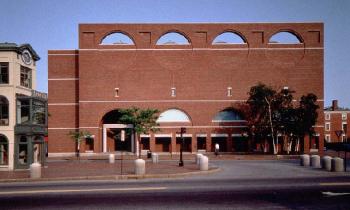
Our group then walked into the first floor rooms of the former museum, before the present building was built in 1983. That completed our museum visit. Then several of us enjoyed a nice lunch in the museum cafa. The chicken-vegetable soup was excellent. I must return to spend several more hours in the museum. It is full of interesting exhibits.
I will include a few lines about the history of the Portland Museum of Art, which were in a brochure I picked up at the information desk.
“The Portland Museum of Art was founded in 1882 as the Portland Society of Art. In 1908 Margaret Jane Mussey Sweat bequeathed to the Society her three-story mansion, the McLellan House (constructed in 1801 by John Kimball, Sr.) and sufficient funds to create a gallery in memory of her late husband, Lorenzo de Medici Sweat. The L.D.M. Sweat Memorial Galleries, designed by noted architect John Calvin Stevens, opened to the public in 1911. Maine native Charles Shipman Payson’s 1976 gift of 17 Winslow Homer paintings and $8 million toward a facility to house them was the catalyst for construction of the award-winning Charles Shipman Payson Building, which opened in 1983 and was designed by Henry Nichols Cobb of I.M. Pei & Partners, The Federal-era McLellan House and the L.D.M. Sweat Memorial Galleries were fully restored in 2002 and were reunited with the Payson building creating a unique museum complex that charts the evolution of the American art museum and explores three centuries of art and architecture.”
Coffee cake
Today’s recipe is one that I used to bake often, after the cake was printed in Parade Magazine.
MYSTERY MOCHA CAKE
3/4 cup sugar
1 cup sifted flour
2 teaspoons baking powder
1/8 teaspoon salt
1 square unsweetened baking chocolate
2 tablespoons butter
1/2 cup milk
1 teaspoon vanilla
Mix and sift first four ingredients. Melt chocolate and butter together over hot water. Add to first mixture. Combine milk and vanilla; add and mix well.
Pour into greased pan.
Combine 1 cup brown sugar, 1/2 cup sugar, and 4 tablespoons cocoa. Sprinkle over the batter.
Pour 1 cup cold double-strength coffee over the top.
Bake in 350-degree oven for 40 minutes. Serve warm or cold.
 Ramblings
Send questions/comments to the editors.
