



David and Robin Dahms were hoping to move into their dream home on Beaver Pond by Christmas.
Built in memory of their daughter, Brittany, who died of cancer last January, the three-bedroom ranch was going to have a deck off the back overlooking the pond, a private back yard where the family could barbecue in good weather and a porch out front that would be the focal point of the home.
“This is what our dream house would be,” said Robin Dahms. “It’s a basic ranch house, but it’s our dream house.”
But, Christmas has come and gone, and the new home – planned to replace their smaller existing home on the same lot – is no more than a foundation and a frame. The pond they were hoping to see reflect sunsets in the evenings has turned the project into a nightmare and has forced the family to alter the design of the house and delay construction for a month.
“We wanted to do this a couple years ago, but my daughter got sick and it wasn’t feasible,” said Robin Dahms. “This is in her memory, and it’s all screwed up.”
Brittany Dahms was a Westbrook High School graduate who died last January, at the age of 19, after more than a year battling leukemia. She was remembered by those who knew her as a kind-hearted young woman who fought against her illness with strength and courage. She was known for the way she accepted the day-to-day sufferings of the last year of her life with dignity and without complaint.
The Dahmses live on East Valentine Street next to Beaver Pond, which stretches from the end of East Valentine to Spring Street and long has been considered to be man-made by the city. A recent decision by the state, however, has changed that designation to natural, which carries stricter regulations over construction.
To build by a man-made body of water, construction cannot come within 10 feet of the water. For a natural body of water, however, state regulations prevent construction from coming within 75 feet.
The problem for the Dahms family is that their property is only 95 feet from the water to the street. What was supposed to be a home facing the street with a front yard and a back yard leading down to the pond, as well as a deck off the back of the house looking out over the pond, is now decidedly different. The house will now face perpendicular to the street with about 20 feet of front yard, 5 feet of back yard and no deck.
“We would have had a huge back yard, but now we have hardly any,” said David Dahms.
Beyond that, the family didn’t find out that the pond had been designated natural instead of man-made until they had finished the design of the home, received a building permit from the city and already torn down their old home.
Restrictions discovered
Back in mid-October, the couple said, they went to Westbrook City Hall to ask about getting a building permit for the home. They said they asked the city if the pond would be a problem, and city staff said it wouldn’t be because the pond was man-made and only required a 10-foot setback.
Diana Brown, assistant code enforcement officer, said that at the time, the plans for the new home were in line with the city’s regulations.
The couple put in their application at the end of October, and received a permit from the city in the beginning of November. On Nov. 6, they brought contractors in and began demolishing the old house, which Robin Dahms said had always been a starter home and which the family had outgrown long ago.
Meanwhile, the Dahmses were unaware of the fact that the city had contacted the Department of Environmental Protection to see if the state had any regulations concerning the pond.
According to Mike Mullen of the Department of Environmental Protection, the responsibility lies with the landowner to contact the state if planning to build near water. However, Brown said she contacted the state because the question had been raised whether the pond was natural or man-made. The city had considered the pond to be man-made because it never appeared in a shoreline zone on city zoning maps going back as far as 1958. But, Brown said, the state had never made a determination whether it was man-made or natural.
Upon receiving the inquiry in mid-October, the state conducted a field investigation of the pond. Environmental specialist Kara Moody said she visited and researched the pond and determined that the pond appeared naturally occurring and not man-made. She said she couldn’t find any evidence that conclusively showed the pond was man-made, even though it might at one point have been included in the Cumberland-Oxford Canal.
The Cumberland-Oxford Canal, stretching from Sebago Lake down the Presumpscot River to Portland, was in service from the 1830s until the 1870s. The canal was an important waterway before railroad provided easier transportation across the region, according to the Naples Historical Society.
After determining the pond to be natural, the state told the Dahmses they couldn’t build as they had planned. Instead, they could apply for a conditional permit allowing them to build within 25 feet of the pond. If they wanted to challenge the determination, the state said, the burden of proof would be on them. The couple did some research and found a drain in the pond that might suggest it was man-made, but Moody said that could have been part of improvements made to incorporate the pond into the canal system.
“We can’t just assume that it’s man-made without proof,” said Moody. “We have to assume it’s natural. This one looks pretty natural.”
The couple halted excavation of the foundation of the house and applied for and received the permit. However, waiting for the special permit delayed construction, and to accommodate the new restrictions, the couple had to alter their construction plans.
Robin Dahms said the state offered a more complicated permit that may have allowed them to keep the plans as they were, but the extended permit process would have set construction back even further.
“We were on a time frame,” said Dahms. “At that point it was too late because we had the excavators coming.”
As for the Westbrook building permit, even though it was already issued, the family still needed state approval for their project because natural waters fall under state jurisdiction. The city had issued the permit based on its own regulations, relying on the landowners to make sure all other permits were in order.
Brown said even though the question of the pond’s status might have still been up in the air, she didn’t feel the city was in a position to hold up the permit if the plans were in line with city regulations. She also recognized that the Dahms family was anxious to build.
“It’s very frustrating and heartbreaking,” said Robin Dahms.
She said they are disappointed because they had planned the new home in memory of their daughter, who always teased them that they would never get their dream home built.
“She told me, ‘You’re full of it. It’s never going to happen,'” said David Dahms.
For now, the family is still staying locally at Robin Dahms’ parents house while they are away in Arizona. Their move could be delayed until as late as the end of January, according to Robin Dahms.
The run-ins with the city and state have taken the fun out of building a new home, the couple said.
“I’ll be excited once it’s up and we can start painting and doing the things we want to do, but for now, there’s no excitement,” she said.
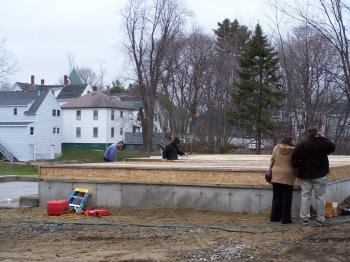 Troubles plague couple building dream home
Send questions/comments to the editors.
