



Sarah Saad watched from a ship’s deck as smoke rose from Beirut, Lebanon, on the evening of July 26, two weeks after Israel had begun bombing. Saad was fleeing the city with her six children, leaving behind her home and her husband, an officer in the Lebanese army.
“We were all crying,” said Saad, who had lived in suburbs of Beirut for seven years.
Aboard the Lebanese cruise liner Orient Queen, Saad was filled with doubts about her decision to leave. Heeding the advice of the U.S. State Department, she had decided to leave only the previous night. She wondered whether she’d made a mistake leaving her husband behind, and feared what was certain to be a trying voyage with her children.
“Can you please let us go back? It’s too hard of a trip with the kids,” she pleaded with a U.S. Marine aboard the ship.
“No, I’m sorry. It’s not possible,” the Marine told her, as the ship sailed on toward the island of Cyprus in the Mediterranean Sea.
That was the beginning of a three-day trip for Saad that would eventually return her to Gorham, where she grew up. Although she and her children are now safe from the violence and deprivations of the war between Hezbollah and Israel, they miss their husband and father. And they face an uncertain future, with their home caught in the middle of a war that never seems to end.
Sarah Jensen graduated from Gorham High School in 1995. She met her husband, Lt. Col. George Saad, in Maine in 1999, while he was in the United States on a training mission. They married that same year, moved to Lebanon and had six children – Nathan, 6; Julianna, 5; twins Kyle and George, 3; Daniel, 4; and Paulina, 8 months.
With Lebanon under attack, George Saad was denied approval to leave the country to help his family get to America.
“I felt so bad leaving George in that situation,” she said.
Saad and her children are now staying with her parents, Jon and Polly Jensen. Although she had her doubts during the evacuation, Saad now feels she made the right decision.
“It worked out for the best,” she said. “It’s less for him to worry about.”
Her husband told her by telephone recently, “I miss you, but I’m so glad you’re there.”
The flight to safety worried Sarah Saad’s parents. “We were frantic with her traveling alone with the children,” said Polly Jensen.
A hard decision
George and Sarah Saad own a home near the U.S. embassy in the suburbs, about three miles from the center of Beirut. Polly Jensen said her daughter’s family was “housebound” during the bombing. “The air was smokey, the kids couldn’t go out because of black dust. Beirut was taking a beating,” she said.
Saad said Israel bombed Beirut constantly in the days before she left. “Mostly roads and bridges,” she said. “They bombed the Damascus road that led to Syria.”
Food and supplies became hard to get. The city was unable to provide water daily, and bread was rationed with one loaf each day per family. Gasoline was rationed and electric service was sporadic. Grocery stores were running out of dry goods like the diapers Saad needed for her baby.
“The situation was deteriorating fast when we left,” Saad said.
Saad wanted some American money for the evacuation journey, but found U.S. currency hard to come by because people in Lebanon were worried about the value of Lebanese money. But she was able to trade with a neighbor for 700 U.S dollars.
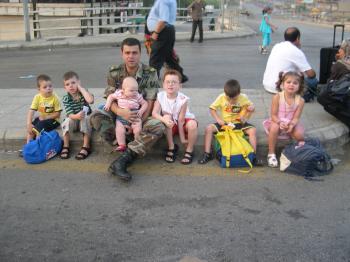
Officials at the U.S. embassy told Saad to be at a marina at 6 a.m. for processing before boarding the ship. Her kids were left sitting on a sidewalk for three hours before embassy officials arrived at 9 a.m. Saad’s mother-in-law fed the kids during the wait.
George Saad, dressed in his Lebanese uniform, walked his family through the checkpoint, where they parted with no time for a long farewell.
‘Only necessities’
Afterward, she had to wait hours before boarding the ship. Lebanese police and U.S. Marines helped her with the children during several passport and baggage checkpoints.
Saad traveled light. She was allowed only 35 pounds of baggage, which she crammed with food, water, diapers, formula and one change of clothes for each child.
“It was evacuation. I carried only necessities,” Saad said.
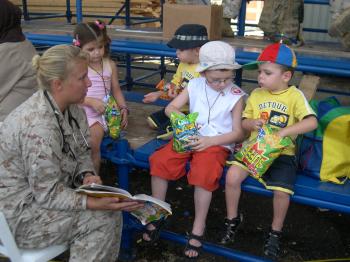
She said passenger baggage was thoroughly checked for bombs. U.S. Marines, armed with “a pile of rifles shaped like a campfire,” were very helpful. “They were great with the kids. They gave them food and water.”
After spending all that day outside, at 5 p.m., they were among about 800 Lebanese Americans, including Muslims and Christians, who boarded buses for the ship. Before boarding the buses, dogs sniffed their baggage. The Marines escorted the convoy of buses. Saad sat with two CNN reporters from England.
Despite the precautions taken before boarding, authorities feared a security problem and the buses turned back. “We were nervous, not a good sign when the buses turned around,” she said.
Finally, they boarded the ship at 8 p.m., 14 hours after their wait began. They stood on deck watching Beirut disappear. She and the kids had a small cabin with two bunks and two portholes aboard the liner, which was escorted by U.S. warships
Her son, Daniel, tried to open a porthole. “It’s going to be a long trip,” she thought.
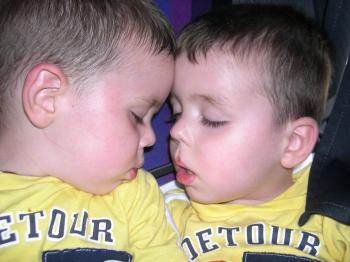
The ship offered food, but she chose to keep the kids in the cabin and they ate sandwiches from their pack. The kids were tired and they slept for the night. Saad became ill. She didn’t know whether it was seasickness or nerves. “I was so sick,” she said.
A horrifying experience
They arrived at Cyprus the next morning and docked by 8. In Gorham, her parents had contacted a congressional office trying to learn the whereabouts and welfare of their daughter and grandchildren.
Her parents were told that they weren’t on the ship’s roster. “That panicked us,” Polly Jensen said.
But at Cyprus, the U.S. State Department located Saad and her children. “They told me my parents were worried,” said Saad, who relayed a message to her folks that she and the children were all right.
In Cyprus, they were taken on a 90-minute bus ride to a building that had thousands of cots inside a big, open area. Some people who had trouble with their papers had been stuck there for days. Saad, who had taught at a private high school in Beirut, met one of her former students, who had been there five days.
“Am I ever going to get out of here?” she wondered. “I was so scared.”
She feared being stranded there with the kids. “What if I fall asleep and the kids walk off?” she worried.
There were no clocks in the building. She found herself confused as to how long she had been there. But soon, she learned they would have to board buses to the airport. She needed help with the kids, and an official offered assistance with the twins and the baby. Saad held onto the other three.
Somehow, the official with three of her kids got in the wrong line and disappeared in the throng. Saad didn’t know where the three were for several minutes.
“It was horrifying,” she said. “I was shaking. I started crying.”
Her fears escalated when a transportation official didn’t know whether he had already put them on a bus. Within minutes, however, her fears were quieted, as her kids were found.
Welcome back
Long lines of refugees boarded buses for the airport where the United States had chartered a flight for them that night. With beefed up security, U.S. marshals were on the plane, which landed in Germany. But Saad and the kids remained aboard.
Scheduled to land in Baltimore, Md., the plane made an emergency landing in Bangor because one of the passengers had a medical emergency. Finally so close to home, Saad asked a marshal if she could just get off there. He told her she could not.
In Baltimore, the plane was met by U.S. soldiers, who applauded when the passengers disembarked. “I wanted to cry. It was such a nice welcome back to America,” Saad said.
She and her children were helped off the plane. The Red Cross, whose volunteers helped watch the kids, met them. “I’m so thankful for the people there,” Saad said.
But she was struck by fear in Baltimore. Her husband had always taken care of their finances, and she didn’t know how to buy tickets and didn’t have enough money. And her kids were worn out by the trip. “All six were crying,” she said. “The kids were exhausted. They were done. My nerves were frayed.”
For the first time since she left Beirut, there were no embassy officials or Marines to help her on the last leg of the trip. “Coming here was financially scary,” Saad said. “God was with me all the way. It was a miracle that we got here.”
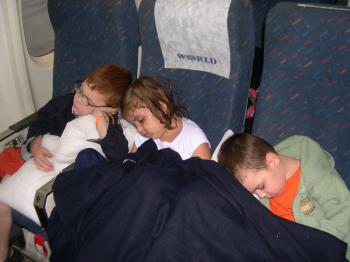
She contacted home in Gorham by cell phone from Baltimore. Her parents paid for tickets to Logan International in Boston. Saad and her children slept all the way. Landing in Boston was delayed three hours by a storm while the plane circled. When they finally landed, she was met by her brother and sister-in-law, Andy and Stephanie Jensen of Bradford, Mass.
“I was so happy to see my brother and his wife. It was a great moment,” Saad said.
They stayed overnight with her brother. The next morning, the kids were running barefoot on the lawn. “They had never been on grass. They are real city kids,” she said.
Her parents picked them up in Massachusetts and brought them home. “It was emotional seeing mom and dad,” Saad said.
Uncertain future
Her dad, Jon Jensen, said his grandchildren have adjusted well after the traveling. The children have learned to swim in the pool behind their grandparents’ home. “God had a plan to get her out,” her dad said.
Saad doesn’t know how long her stay in Gorham will be. “Lebanon is a pretty fragile place. It’s hard to predict what’s going to happen there,” she said.
A U.N-negotiated cease fire went into effect Aug. 14. Saad, however, is afraid if she returns, war will erupt again in a few months. She said the Lebanese army is on full alert. “He’s at work most of the time,” Saad said of her husband.
She said before the cease fire there was always the chance their home would be bombed, but it wasn’t her greatest fear. “It would be running out of essentials and eventually being stranded in Lebanon,” she said. “I wouldn’t want to put my kids in that situation again.”
Saad said schools in Lebanon are housing refugees. Her husband has e-mailed their children’s’ medical records, and she is registering her two oldest, Nathan and Julianna, at Narragansett School in Gorham.
She said it was difficult for her husband to support them in the United States from Lebanon, and she said staying in Gorham puts a strain on her parents.
“I’m trusting in God,” Saad said.
 Cutline (Sarah 107 or 108)
  Cutline (Sarah 109)
  Cutline (Sarah 110)
  Cutline (Sarah 113)
Send questions/comments to the editors.
