



Gorham educators recently witnessed what Napoleon prophesied two centuries ago. “Let China sleep. For when she awakes, she will shake the world,” he said.
“She has awakened,” said Gorham Superintendent Ted Sharp.
Sharp, Gorham High School Principal John Drisko and Assistant Middle School Principal Susie Hanley were among 400 educators from the United States who recently got a free tour of China, courtesy of the HANBAN, an arm of China’s department of education. After witnessing China’s economic growth and top schools, they have returned convinced of the importance of teaching Chinese culture and language in local schools.
The three educators plan to present their observations to local teachers and civic groups. While they said it’s too soon to know exactly what they would propose adding to school curriculums, they said they would like to see Chinese education offered in Gorham or possibly regionally. Sharp, who studied Chinese in college, in particular is a strong advocate for teaching Chinese culture and language in American schools.
He told Drisko on the flight home that helping “our country” understand China would be the biggest challenge. Sharp said many Americans are unaware of what’s happening in China. He knows convincing people here of the importance of teaching Chinese will require a sales pitch.
“There is a price tag on this, but the price tag of ignorance is greater,” Sharp said.
China now ranks as the world’s fourth largest economy. The United States is still the largest. China was sixth three years ago but has since passed United Kingdom and France that are now fifth and sixth, respectively. Sharp said some economists say China could be the largest economy in the world in the next 30 years.
“Their goal is to surpass us,” Sharp said.
With China as a major trading partner with the United States, Sharp said those fluent in Chinese would write their own ticket in the future. He said American higher education is considered the world’s best, but pre-collegiate education is not.
He said cars were everywhere in China with a growing market for them. Exit ramps on highways are labeled in both English and Chinese symbols. Three or four daily newspapers are printed in English.
He saw the world’s largest dam under construction across the Yangtze River, which would control flooding and erosion. The dam also would produce hydropower in a country beleaguered by pollution.
Construction was underway everywhere. “They’re building a city the size of Houston every 12 months,” Sharp said.
‘Behind the eight ball’
In China, the three Gorham educators were assigned to different groups and toured schools in Chinese provinces. Sharp saw schools in the Hubei Province and said China showed their “top tier” schools.
Sharp visited two to three schools each day, and the ones he saw were campus types. “The schools were K through 12,” Sharp said.
He described the physical plants as state of the art schools with the latest in technology. “The kids were happy and well adjusted,” Sharp said.
China is focusing on education, and curriculums are rigorous. On a wall in a classroom, Sharp read a sign in English with an American slogan, “no pain, no gain.”
“We’re not as demanding of our children as we ought to be,” Sharp said.
English is taught in lower grades, and high school graduates in China are bilingual. Sharp spoke with middle and high school students who were fluent in English.
“They spoke the king’s English,” Sharp said. “We’re behind the eight ball in languages.”
Gaston Caperton, president of the U.S. College Board in Princeton, N.J., which helped organize the trip, said more than 200 million children in China are studying English. But there are only 24,000 students in the United States studying Chinese.
John Drisko visited the Shanxi Province. He saw a high school with 6,400 students. Drisko said there were 50 to 70 students in each classroom, compared to 18 to 25 at Gorham High School.
Drisko was told Chinese parents bribe teachers to get their children a front row seat in classrooms. Parents have to pay tuition for children in grades 10, 11 and 12.
Students take exams to determine which schools they attend. An English teacher in China told Drisko the exam system was the only thing in the country that wasn’t corrupt. The communist party selects the principals and the teachers.
Drisko said a typical school day in China begins at 8 a.m. and ends between 5:30 and 6:30 p.m. with a two and a half hour lunch break. Students attend seven or eight classes a day and do another four hours of homework.
One student, who Drisko met, studied at home until midnight. The students are “unbelievably focused,” Drisko said.
‘Sleeping giant’
The high school has astro turf fields for soccer, and other sports there include basketball, tennis, table tennis and track. “They don’t have sports like we do here,” Drisko said.
He said the cities sponsor sports tournaments, but China’s aim isn’t shooting balls through hoops. “Sports is not the goal. The goal is education,” Drisko said.
The school systems there are serious about students learning English. Drisko agreed with Sharp that schools in China are demanding. “Kids rise to the expectations,” Drisko said.
Drisko said people in America aren’t aware of the “sleeping giant.” He said China is producing a million engineers a year.
Drisko believes implementing Chinese into New England schools would be difficult. He said Chinese should begin in second grade, but he favors first teaching Spanish in lower grades in Gorham.
Foreign languages now available at Gorham High School are Latin, French and Spanish. With a school enrollment of about 900, Drisko said 300 students would take Spanish 1,2, 3 or 4, while only 122 students will take French when school opens this fall.
He said the United States is lagging behind the elite schools in China in producing bilingual students. Drisko said China is “up and coming” and that the global economic reality will move American schools to teach Chinese. “You know Chinese, come to work for us,” Drisko said employers will beckon.
Teaching Chinese locally
Drisko pointed out that Westbrook teaches Chinese and thought Gorham students could work out attending classes there. “Let’s get together and offer Chinese culture and language regionally,” Drisko said.
A regional approach could be a possibility. Jan Breton, assistant Westbrook superintendent, said they have two teachers for Chinese. “We’re interested in collaboration,” Breton said.
The Gorham Middle School now has Spanish and French courses. Hanley said local school systems, like the new Sebago Alliance, could band together to teach Chinese. The Sebago Alliance is a group of local school districts – Westbrook, Gorham, Windham, SAD 6 and Raymond – that are looking at ways to share resources.
Hanley said one teacher could perhaps travel around to schools or televised classes could be employed at the high school level. She suggested that students could learn about China and other cultures in voluntary after school programs. “I think there should be a culture club at Gorham Middle School,” Hanley said.
Other possibilities for instituting Chinese here would include exchanges between sister cities, students and teachers. “Chinese teachers seemed eager for outside of China experiences,” said Hanley, who visited schools in the Inner Mongolia province, which has 10 cities the size of Boston.
Falling off the train
She saw American franchises there like McDonald’s, Kentucky Fried Chicken and Macy’s. She said it was strange to see a “huge” Macy’s but no customers. She said 80 percent of China’s people are in poverty.
In an exchange, American teachers could be of help in China. Hanley said China could institute high school on line to reach their “hinterlands.” But Google isn’t allowed in their country.
Hanley sees a paradox under the control of the system. She said the Chinese educational system hopes to produce students who are more innovative and creative to be successful in a global society.
Rural students now have to leave their families to acquire an education. In rural China, the students don’t get the opportunity to study modern English.
She said China doesn’t have adult education in later years for those who don’t pass a critical exam in the eighth grade. “The train moves forward if you fall off,” she said.
Without a social security program, aging parents depend on the success in life of the one child allowed per family. Everyone works, and begging is a job for the handicapped.
Students there were eager to learn about lifestyle in the United States and questioned Hanley. They asked whether the United States had beggars and about the Internet, chat rooms and dating. Hanley said dating among students is low key, “hush-hush.”
She said China, which burns a lot of coal, needed to go “green” to help alleviate pollution. She said the exteriors of buildings are grimy. She believes pollution and the lack of improved education for the rural masses are two hurdles impeding China’s rise to greatness.
Hanley plans to meet with parents in forums and create a display for the middle school library. She said part of the responsibility of being selected for the trip is sharing it with others.
“It rocked my world,” she said.
 Cutline (China 5437) reat Wall.
 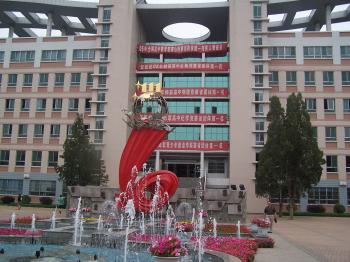 Cutline (China 5548)
  Cutline (China, Susie)
Send questions/comments to the editors.
