



Just after a cup of coffee one morning, Rick O’Donal was at work at the Storey nursery in Pride’s Corner hanging baskets one morning when he collapsed. His heart stopped.
At that point, O’Donal had a 2 percent chance of survival, according to statistics. This wasn’t a movie. In real life, only 2 percent of people in cardiac arrest are saved.
Lucky for him, rescue was immediate and effective. He was clinically dead for about seven minutes, and then Westbrook EMTs, with some help, brought him back to life. Now he’s back at work, taking care of his health and feeling better than he did before the heart attack.
O’Donal is the head supervisor for Lloyd Storey, who owns Storey Family Greenhouse and Garden Center and who worked as a Westbrook firefighter for 25 years before retiring as a captain. Lucky for O’Donal. Storey helped save his life.
Storey said O’Donal had just gone into another nursery and then he heard Jeff Gallant, another worker at the nursery, yell out that O’Donal had collapsed and looked like he was having a heart attack. Storey reacted instantly.
He went to O’Donal, who was lying on the ground, and immediately checked for a pulse. Thirty seconds had passed since he’d collapsed, but it was already gone. Storey began mouth to mouth.
He told Gallant to get on the phone and call 911, which he did. Gallant was gone for less than a minute, and then Storey had Gallant give compressions while he continued giving mouth-to-mouth. Storey talked him through it.
The two worked on O’Donal for two or three more minutes. In the meantime, dispatch at the public safety building had gotten through to firefighter EMTs Andrew Stevenson and Eric Beecher at the Pride’s Corner station, and the two of them raced over in a fire truck.
Flatline
Beecher pulled up to the nursery and Stevenson ran in. Beecher passed a portable defibrillator to a bystander who took it in, then he followed with more equipment. When he got into the building, Stevenson had the defibrillator pads attached to O’Donal.
The defibrillator the EMTs had with them was a portable model used when the more advanced equipment in an ambulance is unavailable. At the time, the ambulance for the Pride’s Corner station was in downtown Westbrook. All the EMTs had was the portable.
When Beecher got in, the defibrillator was showing O’Donal in cardiac arrest. Stevenson shocked him, but it didn’t work. O’Donal had flatlined.
Stevenson said he started manual compressions while Beecher worked to get air into his lungs using an oral air tube and a squeeze bag. O’Donal vomited. He wasn’t alive, but air had gotten into his stomach and his body reacted. Beecher cleared the vomit and continued to give him air. Thirty seconds passed.
With manual compressions and forced air, the two EMTs were artificially keeping oxygen pumping through O’Donal’s body, although he was clinically dead.
And then he wasn’t. The portable defibrillator registered a rhythm, and they both stopped what they were doing. Stevenson checked for a pulse and found one. A weak one, he said. But a pulse nonetheless.
Just then the crew from Westbrook showed up with the ambulance. They put O’Donal on a gurney and took him to the ambulance. On the way to Maine Medical Center in Portland, Stevenson gave O’Donal fluids intravenously and analyzed his heart using the monitor in the ambulance. O’Donal was breathing on his own on the way in. At the hospital, the emergency crew there took over.
‘Along for the ride’
O’Donal said he doesn’t remember a thing about the heart attack or anything from that day or the next two days. He said he woke up in the hospital not knowing what had happened to him.
He said the nurses at the hospital were calling it a miracle he’d survived. It just doesn’t happen very often in cases like his. According to Westbrook EMS Director Ron Jones, he had one chance in 50 of surviving.
Beecher said some paramedics work entire careers and never have someone go down like that and come back. Stevenson said in the four years he’s been a paramedic, he’s seen probably 40 or 50 people go into cardiac arrest, and only three of them have come back. And O’Donal’s case was not asphyxia or drug overdose but the heart simply failing, which makes it even more rare, he said.
On top of that, it’s even more surprising because Stevenson didn’t use any drugs in the process. He said he would normally have used drugs immediately, but he wasn’t riding in the ambulance like he usually does and didn’t have any. He said on one save he used 19 rounds of drugs.
“This hardly ever happens,” he said. “Usually when someone goes down, they don’t come back. It’s not like TV.”
Stevenson said what saved O’Donal was early intervention, and Storey agreed. Storey said normally people lay longer before any help comes, but in O’Donal’s case the help was instantaneous with he and Gallant and then Stevenson and Beecher.
“If you’re going to have a heart attack, that’s how to do it,” said Storey.
O’Donal is grateful to Storey and Gallant and the two EMTs who saved his life. “Thanks to Mr. Storey, Jeff and Westbrook fire and rescue,” he said. “It’s all thanks to them. I just went along for the ride.”
O’Donal said at the hospital he received double bypass surgery to repair his heart and rebuild a damaged valve. He also received an internal cardiac defibrillator implanted in his chest that will shock him automatically if his heart ever stops again.
Of course, he’s hoping that won’t be the case. He said he’s taking much better care of himself after spending a month in the hospital and two weeks at home recovering before coming back to work.
He said he used to smoke a pack and a half of cigarettes a day and drink eight or nine cups of coffee, although he’d never had any heart trouble and no warning of the heart attack. Now he’s quit smoking and only drinks a cup or two of coffee a day. He says he feels better than before the heart attack.
“You learn your lesson pretty quick from that,” he said.
O’Donal said his doctor is pleased with his recovery and said his heart has come back stronger than expected. He also said he didn’t have any brain damage because he was brought back to life so quickly.
“The fire department, Lloyd Storey, the nurses, and the doctors,” he said. “I can’t thank those people enough.”
 Rick O
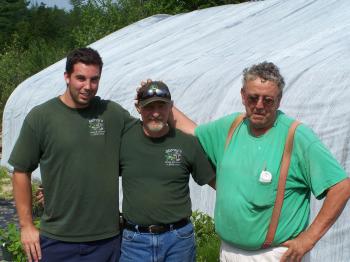 Rick O
Send questions/comments to the editors.
