



When Canal School fourth-graders toured Idexx recently, they got to see science in action at a company they might work for one day.
The Junior Achievement class taught by Idexx financial analyst Ron Greco focuses on teaching the kids how businesses use Maine’s resources. By bringing them to Idexx, he was able to show them first-hand how that works.
Touring some of the production labs, the kids got to see some of the products Idexx develops. After that, they got to use one of Idexx’s products, doing their own tests for bacteria in drinking water.
“It makes you think if you put your mind to it you could make inventions like that stuff they do here,” said 10-year-old Joey Champagne. “If nobody thought of stuff, there’d be nothing.”
The tour was part of Idexx’s effort to give kids of all ages insight into what’s possible after their schooling is done, right here in Westbrook. In addition to the fourth-graders, the company gives tours to students in every class level, including college students.
The tour the Canal School kids got was a relatively simple one, focusing on a few products and a basic business model of money-in minus money-out equals profit. But the company has also hosted University of Southern Maine students.
“We always need to know what the teachers goals’ are in bringing them so we can customize the demonstration,” said Dominique Foley, Idexx business communications associate.
Foley said the company usually gives tours to science students, including a toxicology class from the University of Southern Maine. The tours generally include a look at the facilities and a demonstration based on the students’ level of understanding.
For the fourth-graders, they were asked to drop test tablets into 100-milliliter sample bottles filled with water and look for a change in color that indicates the presence of E. coli bacteria. E. coli are mostly harmless bacteria that live in the intestines of humans. However, some strains produce a powerful toxin that can make people sick.
For the demonstration, Maureen Caine, a 13-year Idexx employee showed the class what contaminated samples look like – copper in color, indicating the presence of bacteria. When she turned off the lights and the room went black, squeals and giggling could be heard throughout the room.
Caine then put the samples under a black light, and the contaminated samples glowed a milky blue, which drew “oohs” and “ahhs.”
Caine asked the kids to put the water into sample trays, and some of them got to seal the trays up. While Megan Zabenko, 9, stood by, Hayley Bell, 11, fed their tray into a machine about the size of a desktop printer. After sealing it up, their sample would normally sit for 24 hours before being tested with the black light.
Although it was doubtful Bell’s sample would yield E. coli because it came from the drinking fountain around the corner from the room, the process she followed was the same as done by workers at actual water facilities testing drinking water.
“I learned how we get our water,” said Zabenko.
The adults involved in the process all agreed that it’s good to get kids out of the classroom so they see what adults are doing in the real world. It’s also important to get kids thinking about their future, even at a young age.
“Teachers want their students to understand there’s a life after science class,” said Foley.
Greco said he tries to teach his “Regions and Resources” students about Maine’s resources and how businesses use them. During the tour, he quizzed them about Maine’s resources and about the basic business model.
“It gets them started thinking about why businesses are where they are, like why we have so many paper mills in Maine,” he said.
Greco teaches the Junior Achievement class for one hour once a week for six or seven weeks. He said Idexx has always been supportive of his involvement in the community and is very supportive of helping in the community in general.
“The students have learned a great deal from Mr. Greco,” said Riley. “They have a much better understanding of the various resources that it takes to run a company, as well as learning about profit and loss. They now know that it takes a bit more than they thought in order to have a company actually make money.”
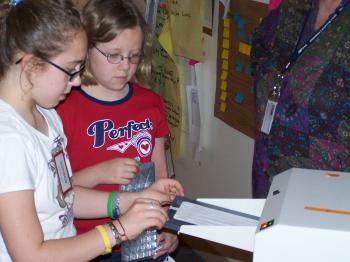 Hayley Bell, left, and Megan Zabenko
Send questions/comments to the editors.
