



Spring in Maine.
Bright sunny days, vivid blue skies, sparkling lakes.
And sand. Sand tracked into and vigorously swept out of homes, businesses and schools everywhere.
But no one this time of year has to deal with as much sand as local public works departments.
While everyone wants it gone, has anyone wondered where it all goes?
Raymond’s Public Works Foreman Nathan White estimates that as much as 60 percent of the sand that’s put down in the winter gets swept back up in the spring. He says in the school parking, alone, the amount collected approaches 18 cubic yards.
Street sweeping is not an inexpensive task. White says a new sweeping machine costs about $110,000 and has a 10-year life expectancy.
For many years, Raymond never picked up the sand. Instead, crews simply pushed it back off the roads and onto the shoulders.
But five years ago, the town bought a used sweeper from Gray. And this year, they contracted John DeMarco, owner of Portland-based B&G Sweeping, to do the job.
According to DeMarco, street sweeping is a slow business.
“We go two to three miles per hour,” he said. “In heavy conditions, one mile per hour is top speed.”
The machine sprays the sand lightly with water to keep it from forming a cloud of dust as it’s brushed from the road. Even so, DeMarco wears a mask when he sweeps to keep from inhaling the dust particles.
As public works’ trucks become filled with sand from the sweepers, they must get rid of their load. In Raymond, the sand is pushed over the edge and into a gravel pit near the public works building.
“Some towns have been forced to haul it,” White said.
He says the Department of Environmental Protection considers sand a greater hazard to lakes and streams than salt, causing him to speculate that the collected sand will eventually be looked at as a hazardous material.
For now, according to Carole Cifrino, an environmental specialist in the department’s Division of Solid Waste Management, sand is considered inert fill.
“You can’t put it in wetlands or streams or lakes, but you can put it near wells,” she said.
Cifrino added that the sand is different from storm sewer grit or sediment from stormwater runoff ponds.
“Anything cleaned out of that is a solid waste,” she said.
Many Lakes Region communities do provide the collected sand to residents for fill. Edra Long, of the Windham Public Works Department, says they require residents to fill out paperwork, specifying the intended location, and then someone from the department inspects the site to make sure it’s not too near water.
Windham streets require about 450 man-hours to sweep, said equipment operator Steve Long. He says in the spring the department collects about a third of the 6,000 to 7,000 cubic yards of sand that is spread in the winter.
Although much of the sand blows away from more heavily traveled roads, the streets with curbs or those that have lower speed limits need more sweeping.
“And we make sure to sweep all areas, like Cottage Road, that are around the shore, to prevent sand from getting in the lake,” he said.
According to Town Manager Derrick Goodine, Naples doesn’t do much, if any, sweeping beyond the causeway. He said the town uses a tractor with circular brooms to push sand toward the shoulders and if there’s a lot, they’ll fill a dump truck and give it to people for fill or will use it for gaps in the road shoulders. Sometimes they dump it into a gravel pit.
“A lot ends up in ditches,” Goodine said, “and I want to clear that out and let the water flow.
In Standish, Public Works Director Roger Mosley says the town sweeps about 35 to 40 miles of subdivision roads, which takes them four weeks to complete. They contract the sweeping and dispose of the sand by burying it in an unused gravel pit on Bounty Road.
“If we’re doing roadside ditching we’ll give it to people as fill but the sweeping material, we bury,” Mosley said. “I control it by keeping it on our own property.”
While salt is now considered safer for lakes and streams than sand, most public works officials agree that a mixture of the two is needed to melt ice and provide better traction.
If someone could just come up with a material that combined the best of both, it would make everybody happy. Except, perhaps, the street sweepers.
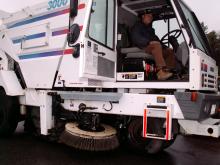 Equipment operator Steve Long sits in a street sweeper owned by the town of Windham. Like the sighting of a robin, seeing this machinery scrubbing sand off local streets is a sure sign that winter is over.
Send questions/comments to the editors.
