



Some people were out raking leaves last Saturday but a group of firefighters was out burning them.
Actually, responding to a controlled burn in the field next to the Standish Municipal Building was just one part of the day’s training for the 20 area firefighters. They attended three stations during their eight hours of field training, which is one of the required components of Red Card certification.
And once firefighters pass their field training from the Maine Forest Service, along with 24 hours of classroom training, a physical fitness test and a lie detector test, they are qualified to fight wildland fires in other states.
Ranger Matthew Bennett, of Lyman, directed the training, assisted by rangers Claudette Desautels, of Lyman, and Art Lavoie, of West Paris.
During their day, the firefighters, seven of whom were from Standish, divided into three groups and rotated through the stations.
Standish firefighter Captain Brent Libby took the course to increase his knowledge of fighting fires in what’s called the “urban interface” – regions where forested areas meet developed areas. Most of southern Maine is considered to be in this category.
Although his goal is not necessarily to go out west to fight huge wildland fires, Libby enjoyed the training and felt he learned principles he will be able to apply in Standish.
He also spoke highly of the Forest Service, which is notified of any outside fire the department handles.
“The Forest Service has started to become very proactive,” Libby said. “Matt (Bennett) stops in frequently and we have a good relationship with them – we know each other by name.”
Bennett taught the Hand-line Construction station, in which the groups learned how to create a firebreak by using pick-axes to dig through the “duff,” which is flammable material such as leaves and peat moss, down to a mineral soil strip. The process includes breaking through any tree roots that could burn underground. A firebreak can keep a fire from spreading along, or slightly under, the earth’s surface.
As part of this station, firefighters also learned how to use a fire shelter – a last-ditch effort to protect themselves if trapped by a fire. Although the group used practice shelters made out of a tarp-like material for the exercise, genuine fire shelters are made from a reflective tin-foil type of fabric that helps keep out the heat.
In this dangerous situation where every second counts, firefighters must instantly be able to remove the shelter from its pack, crawl inside and drop to the ground, encased in what looks like a body bag. There they must stay, holding the edges around them, until the fire passes by.
While that may not sound too difficult, trying to open the shelter while running or to climb inside it with the strong winds that precede a roaring blaze that can blow the shelter every which way is not so simple. Practice is key and could save lives.
Ranger Desautels taught the Map, Compass and Pacing station, which trained firefighters how to follow instructions regarding travel distances in unfamiliar areas and areas where there are no landmarks.
This station also helped firefighters get their bearings and learn what their particular 100-foot pacing is, since everyone paces differently.
Led by Ranger Lavoie, the third station instructed the group on pumps and water use. When fighting a wildland fire, water usage techniques are quite different from those employed in battling a house fire.
Fighting a structural fire requires a large volume of water at low pressure. But for a forest fire, high pressure and a small volume of water are needed to pump 1,000 feet into the forest, to pump up elevations and to conserve water.
When rangers fight these wildfires, they use portable pumps to move the water from the dump tanks they set up – tanks filled by a convoy of tanker trucks that constantly transports water to the site. If battling a blaze on a mountainside, they may have several dump tanks and pumps to carry the water up the slope.
The group completed its day by extinguishing the controlled burn in the field and by a short ride on a helicopter used to fight forest fires.
Bennett says it takes the experience of being in the action to realize the amount of “hard work and organization that goes into coordinating the fire fighting efforts.” And he says he has a “love-hate relationship” fighting these fires.
“You love to be out in the wilderness working hard but your body takes a beating,” he said.
In addition to periodic training sessions such as this one in Standish, the Maine Forest Service conducts a two-weekend training each June. The Maine State Wildfire Training Academy will be held June 3 and 4 and June 10 and 11 at Thomas College in Waterville.
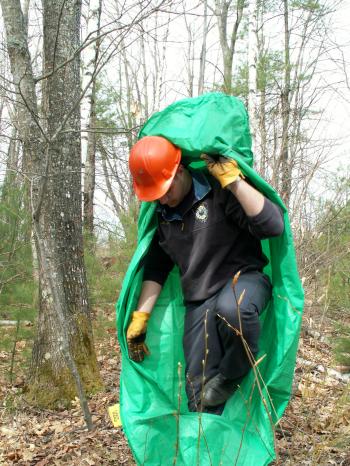 Standish firefighter Captain Brent Libby climbs into a practice fire shelter. Real shelters are made from a reflective material to keep out heat.
Send questions/comments to the editors.
