



In a warehouse in Raymond, John Kendall runs a casino chip manufacturing operation that produces 40,000 chips a day. And demand is constant with Chipco International being only one of two companies in the world that creates playing chips for top casinos across the globe.
Equipment in the warehouse, such as injection molding machines and robots, are worth millions of dollars and cost the company severely in personal property tax each year.
Under the Business Equipment Tax Reimbursement program, the state reimburses businesses after local towns collect the tax. But the state broke its promise of full reimbursement last year, Kendall says, and now only gives back 90 percent. This means a loss of thousands of dollars for Chipco and makes Kendall wary of expanding.
It’s also taken the state up to six months to reimburse his business after Chipco’s paid the business tax. And this all comes at cost to local business and overall economic growth in Maine, Kendall says.
“These events come at a cost of being able to attract new business,” Kendall said. “They come at a cost to update businesses and stay competitive in a global economy. And they come at a cost for proper planning to grow your business.”
It’s tough convincing businesses to move to Maine, he says, especially since Maine is considered one of the “worst states in the nation to invest.”
But lawmakers in Augusta are hoping to change all this with the repeal of the business equipment tax. The bill is still being wrangled in taxation committee. Both sides of the political aisle seem to agree that the tax should be repealed, but disagree on how to do so.
Rep. John Robinson, R-Raymond, is co-sponsoring the bill. As a former owner of a textile manufacturer in Oxford County, Robinson says he understands the pains of the business community and the mistrust businesses must feel after seeing the reimbursement program reduced last year.
“Obviously, if you’re a growing business, it certainly put a monkey wrench in many business plans,” Robinson said. “The last thing you want to do is have an uncertain future. I think it’s a very strong message to send to our businesses that we won’t be monkeying around with this program anymore.”
If the bill passes, business equipment purchased after April 2008 will be tax exempt. All business equipment prior to that date will remain on the books, taxed accordingly by the towns and reimbursed by the state through the reimbursement program. However, big box stores, like Wal-Mart Supercenters, with more than 100,000 square feet of retail space, do not qualify and will not benefit from the bill.
With the bill in place, towns would then be reimbursed by the state for 50 percent of lost tax for new business equipment. For mill towns, where more than 10 percent of tax revenue comes from business equipment tax, the state would reimburse the complete loss in taxes from the repeal.
The hope is that local businesses will then have incentive to buy new equipment and expand while outside businesses will be encouraged to invest in Maine. This would stimulate economic growth that should cover the town’s loss in tax revenue, Robinson said.
But the Maine Municipal Association doesn’t see things that way. They believe this is not a tax break rather than a tax shift onto the shoulders of residential taxpayers.
“We have concerns with the bill as drafted,” said Jeff Austin, lobbyist for the Maine Municipal Association. “We believe that there’s been some overstatements on the need for the bill. We don’t think the BETR program is broken.”
The Association is also skeptical that the state will honor all layers of the law and its reimbursement commitment to the towns. Austin disagrees with the argument that since the repeal will only affect new business equipment, the towns won’t see a real loss. Towns anticipate the replacement of business equipment in terms of new revenue, calculate that in their budgets and therefore would feel the “pinch” from the 50 percent loss.
The Association is advocating for a broader approach to fix Maine’s tax situation and for reform to the bill currently being debated in state Legislature.
Raymond Town Manager Don Willard has taken a “wait-and-see” approach to the bill, though he’s been in close contact with Rep. Robinson on the issue.
“It’s going to result in a total $16 million loss in revenue to the town over time,” Willard said. “The town will have to cope with that if it passes.”
Naples Town Manager Derik Goodine is skeptical about the state’s promise of reimbursement and questions where the state savings will go.
“They should make the communities whole and pay 100 percent that’s lost or find some way to recoup that,” Goodine said. “My biggest disappointment is that the state is only willing to give us 50 percent and pockets the rest.”
Tom Saunders, owner of Shops at Sebago, says a repeal of the business tax would take a burden off small businesses.
It takes time and money for small businesses to account for the business equipment tax and file for state reimbursement.
“It’s just another accounting headache,” said Saunders of the reimbursement program. “The tax issue is a huge part of it. Maine’s almost an unreal place to do business.”
Barbara Clark, director of the Sebago Lake Chamber of Commerce, believes a repeal of business tax would bring more business into Maine, help others expand and allow more to open their doors.
The reduction in the reimbursement last year hurt many local businesses and generated a mistrust of state government from some business owners. But Clark advocates for business owners to keep in touch with their state representatives and let them know their concerns.
“Local businesses are just still feeling starry eyed,” said Clark. “We’re just feeling that the state is not doing enough to help business. We feel we are just getting more and more taxes.”
Clark says a repeal of the business equipment tax is a start to making Maine a more business-friendly state, but much more needs to be done to help local business.
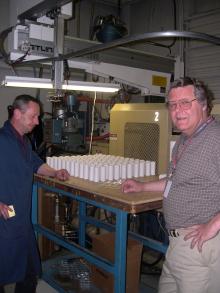 John Kendall stands next to injection molder and robot that stacks the casino chips he creates in a warehouse in Raymond. Kendall says it the business landscape.
Send questions/comments to the editors.
