



Construction of the long awaited Gorham bypass will get underway next year, state transportation officials said last week.
About 100 people attended a Maine Department of Transportation informational meeting about the project last week in Gorham. “We want to catch everybody up to speed,” said Shawn Smith, an MDOT spokesman.
Transportation officials said the bypass would divert 10,000 cars a day from Gorham Village. There are now about 40,000 vehicles, including many trailer trucks, cutting through the downtown.
The 3.4-mile southerly bypass will link South Street south of Waterhouse Road to Route 25 west of Cressey Road. The project does not include a northerly bypass. The bypass will have two 12-foot travel lanes and paved shoulders, totaling a strip of pavement 40 feet wide.
The bypass will have traffic signals where it intersects with South Street and Route 25 but the intersection at Narragansett Street could be a roundabout. Lisa Sauvageau of Briarwood Lane asked about safety of her children who get on school buses on Narragansett Street. Smith said that engineers needed to look at safety.
A bridge on Flaggy Meadow Road will carry traffic over the bypass. Access to the bypass will be limited to the three numbered highways. Abutting properties will not have access to the bypass, which would be fenced.
Dan Aceto of Waterhouse Road, whose property lies in the path of the bypass, asked about where the centerline would be located.
Smith responded by saying that the first step is “nailing down” where the center of the road would be located in a 200-foot right of way. Smith said the study would allow flexibility to move the centerline 15 to 20 feet.
“It’s pretty much etched in stone,” Aceto said.
MDOT officials said they are ready to start preliminary engineering. Engineers are now gathering data on a ground survey. The end of the bypass where construction would begin hasn’t been determined yet.
Joe Nixon of Ossipee Trail questioned the placing of the bypass intersection on Route 25 near a stone quarry where slow moving trucks would likely impede traffic. Ray Faucher, project planning engineer for MDOT, said the design had to avoid streams in the Brandy Brook Hill area.
Faucher explained the alignment. He said it had to avoid wetlands, residential areas, flood plains and natural resources. “We tried to identify the best place for an alignment,” Faucher said.
Will Hansen of Waterhouse Road asked if plans called for stripping the 200-foot wide right-of-way. Smith said they would try to keep some trees for a buffer and to keep noises down. They might not clear all the trees to the width of the right-of-way.
With the number of large trucks that would be using the bypass, noise is a concern for many residents. Faucher said MDOT did a noise analysis and found that a noise wall wasn’t feasible. He said that local communities have the authority to enact truck engine brake ordinances.
Residents were concerned about acquisitions of property. The bypass will divide some large tracts. Property owners were told that appraisers would evaluate the properties and make fair market value offers.
Homeowners close to the bypass were concerned about the highway devaluing their property and how the town would evaluate them. Town Manager David Cole said that if future sales indicated reduced values then the town evaluations would go down.
Hansen also had concerns about wildlife. The area has a deer herd and Smith said that animal crossings would be looked at.
Introducing the agenda to the turnout, Cole said the study that produced the bypass was the 16th study in 45 years. The bypass finally got money approved when Congress earmarked $15.7 million for the bypass last summer in a federal transportation bill.
Smith said that the money allocated would likely pay for most of the construction. “It’s in the ball park,” Smith said.
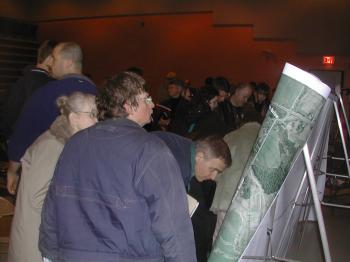 (G bypass 2) – Gorham residents view a map showing the path of the Gorham bypass. State transportation officials said construction would begin late next year,
Send questions/comments to the editors.
