



Ed’s note: National Sunshine Week, a week in which media outlets around the country remind and inform citizens of their right to government information, offers this newspaper a chance to explore what is public and what’s not at our local town halls and schools. Using Windham as a case study, we hope this article sheds light on your rights as an American.
Local government is democracy in its most intimate form.
While many Americans believe most crucial decisions are made in Washington D.C., state and local governing bodies make decisions everyday that impact local residents.
In Maine, annual town meetings and citizen-initiated referendums offer tangible opportunities for people to guide local decision-making. For this reason, public access to government is seen as vital to the health of local communities.
As a matter of state law, all citizens are entitled to view public records and attend public meetings to stay informed. It is a way of keeping the doors of town government open and ensuring the public’s right to know what’s going on behind scenes.
To illuminate what is and is not available to the public, this article will focus on three different arenas of local government: municipal, school and public safety.
Need a property deed? Curious to find out how students are succeeding at your school? Worried there might be a sex offender living in your neighborhood? Read on and find out the information you are entitled to.
Clerk’s office: municipal government working for you
The town clerk is the official record keeper of town history.
In Windham, Town Clerk Linda Morrell records and files detailed minutes from weekly Town Council meetings.
These minutes date back to 2001 in electronic form and are available to the public via e-mail or by hard copy. Videotapes of weekly meetings can also be borrowed from the town hall.
In addition, all the town’s “vital records,” (i.e. births, deaths and marriages) are available if requested by resident’s name.
Tucked away downstairs in the town vault, vital records and town meeting minutes date back to the late 1700s cramped on shelves in a fireproof room.
In recent years, residents in search of their ancestors have used such resources to research their family history.
Assessing: Your land is town record
The tax assessor’s office contains a plethora of public information about land owned by residents and business owners in a community.
“Everything in this office is public record,” says David Sawyer, Windham’s tax assessor.
That includes town tax maps, annual tax commitment books, property deeds, subdivision plans and business or personal property account information. On file are “tax record cards” that contain a picture of a property, name and address of owner, its assessed value, building footprint and any additions to the main structure.
Much of this information is also available online through most town Web sites along with current town tax maps.
In Windham, electronic access to these records via the Internet drew fire last fall as town councilors and residents spoke out in fear that personal information might fall into the wrong hands through the simple click of a mouse.
As a result, Windham residents now have the opportunity to ask by written request that their property information be removed from the online database. The Windham tax assessor’s office has received 80 to 100 letters so far with this request.
Currently, minimal information is available online at www.windhamweb.com, including homeowner’s name, address, assessed value, property taxes and brief summary of building type.
Sawyer is working on a more expansive Web site that would include all information that is public record on the tax cards.
Many mortgage brokers and real estate agents use this online database as do residents who often check to verify whether their property information is correct. This allows the public to dispute assessed values before receiving their property tax bills and has helped the assessor’s office keep more accurate records, Sawyer says.
Planning: Residents reserve the right to view all potential development
The town planning office is ground zero for all pending commercial and residential development in Windham.
Whenever a store expands, a homeowner puts on an addition, a business looks to build in Windham or a developer plans to build a multi-house residential neighborhood, all applications and permits go on record for scrutiny in the public eye.
Files are created for pending building projects in Windham. These files often contain planning memos, decisions by the planning board, other memorandum, surveys and permits for the land, and so on. Planning board minutes are also available to the public at the office.
The office typically sends out notices to abutters of a potential development, but all applications and information are available to any member of the public.
Town Manager’s Office: An eye on finance
Annual budget information and end-of-the-year financial audits are available in the town manager’s office.
The office holds personnel records of who works for the town, what they do and what they get paid. Personnel profiles are held confidential, but the public does have the right to see whom the town employs and what they are paid for their services.
Recent town correspondence, citizen complaints, and studies performed on behalf of the town are also available to the public. Sometimes this information is difficult to find, says Windham Town Manager Anthony Plante, so residents are encouraged to call ahead.
Plante sees the openness of government information to the taxpaying citizens as “absolutely necessary.”
“I think there are some legitimate reasons for keeping some information confidential, but those are few and far between,” Plante said. “Our democratic system depends on openness and transparency.”
Public schools: Measuring success in education
While all student information is held confidential, the public has the right to review school costs, standardized assessment and school profiles.
A school report card on how a district at all grade levels matches up with state and federal standards is available at the office or online through a comprehensive Web site, www.schoolmatters.com. This site includes Maine Education Assessment results as well as an Adequate Yearly Progress report as dictated by the federal No Child Left Behind Act.
On record at the school superintendent’s office, parents may review brief teacher profiles that include their educational degrees and experience. Copies of teacher’s union contracts and administrator salaries are also available.
In Windham, current school policies, like athletic eligibility, are available at the office, but, due to constant changes, the most current policies can be found online through the school’s Web site, www.windham.k12.me.us
Minutes from Windham School Board meetings are available to the public. However they lack detailed discussions like the Town Council minutes and primarily record what actions are taken at the meetings.
All school budget information and end-of-the-year school audits are also available.
Public safety: Serving your community
By law, a daily log of police calls must be made available to the public upon request.
In Windham, any resident may request a police log if they give a certain time-frame for the calls. The log information is brief and includes only names and addresses of arrestees, type of call and the action taken by police officers. Names of minors (under 18) are not released.
For motor vehicle accidents, the public has the right to view accident reports once they are complete.
Full reports are available online through the state’s online database, www.informe.org. While these reports may be tricky to read, (a code key is required to interpret the information), they do include detailed conclusions in the accident cases. The state charges $10 per report.
Windham police also keep an ongoing sexual offender registry that lists convicted sex offenders in town. Detailed information is available online through the sex offender registry at www.informe.org, including a criminal history for a fee.
Access is key
The general rule of thumb on what is and is not public record is that, “any (government) record is a public record unless it is exempted” by state law, says Mal Leary, president of the Maine Freedom of Information Coalition.
“This goes to the fundamental nature of democracy,” Leary says. “How can we exercise our judgment to vote on an issue, or for public officials, if we don’t have all the information?”
Restrictions on public access often revolve around pending contracts, privacy issues involving town and school staff or police matters. For instance, an ongoing police investigation could be compromised if pertinent information was opened to the public before the investigation was complete.
But some state and federal agencies have used the issue of national security to put further restrictions on access to public records, says Leary. There is also debate in the U.S. Congress concerning public access to vital records such as birth certificates in fear that criminals might obtain vital records to commit “identity theft.”
Electronic access to public records like property tax databases is not just an issue in Windham, but one debated across the nation, he says.
“This is where we get into the constant tension in democracy,” Leary says. “You always are going to have that tension in the democratic system between the need for transparency balanced with the inherit right to privacy.”
Electronic access is one aspect of the ongoing debate surrounding what is considered public record and how much information should be open to the public.
But clearly without public record, Leary says, citizens would lose a valuable resource for their private lives, an essential tool in keeping tabs on government at all levels and their right to be informed and a part in the democratic process.
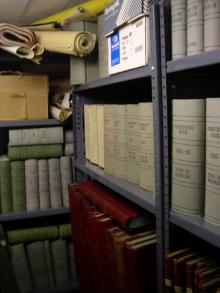 Books in Windham’s 200-year-old archive line the shelves of the town vault, located in the basement of Windham Town Hall. Public records, such as accounts of town meetings, tax maps as well as birth, death and marriage certificates, are all eventually stored here. All these records are open to the public under the Maine’s Freedom of Information law.
Send questions/comments to the editors.
