



Julia Skalina observed the Jewish Passover on March 25, 1945, in the bleak barracks of a German concentration camp. “Most of us were crying,” she said about the group of girls in the barracks.
Days later, Skalina would be free but alone, as her immediate family had all been killed. They were victims of the holocaust in which six million Jews were killed in Europe. Her mother and grandmother died in the gas chambers at Auschwitz, a Nazi concentration camp in Poland.
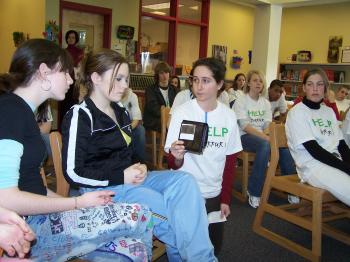
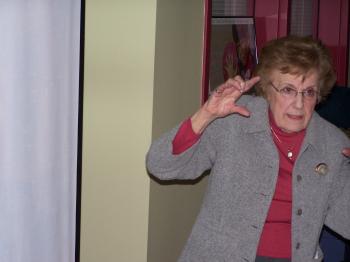
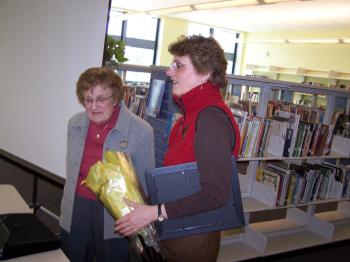
Skalina, a native of Czechoslovakia, told her story last week to students of teacher Sara Needleman at Gorham Middle School. It marked Skalina’s 100th presentation at schools and colleges. “It’s very hard for me to talk about it,” Skalina said.
She said many other survivors couldn’t speak about the horror. ‘I have to speak up for those who never could,” Skalina said.
Hoping that giving her personal account would help deter future hate crimes, Skalina talks with the new generation. “The biggest hate crime of the 20th century is the holocaust,” Skalina said.
Skalina, then Julia Lissauer, and her brother grew up in a five-room house in a small town in Czechoslovakia where she finished high school. Her dad owned a pharmacy. “I grew up in a loving family. I had a happy childhood,” she said.
She was 13 when the southern part of the country that included her hometown was annexed to Hungary in 1938.
Her brother was conscripted into the Hungarian Army. The Jewish boys couldn’t wear a regular uniform and weren’t allowed weapons. Assigned to a labor battalion, her brother dug ditches.
In March of 1944, Germany occupied Hungary. “The fate of the Jews was sealed. Our situation was desperate,” she said.
Her father was stripped of his business. Her grandmother, who lived several miles away, went to live with Skalina’s family as the persecution grew worse.
Jews were confined to a ghetto, which included the street where Skalina’s family’s home was located. Their household numbered five including a cousin but 13 other people moved in because of the restrictions on where they could live.
At the end of May 1944, Germans seized all the family’s valuables. Their home was searched and Skalina and her parents were interrogated on June 2. Her father, who was “terribly beaten,” died following a second interrogation. “My father was the first victim of persecution in our town,” she said. “My father’s memory is sacred to me.”
The family was forced out of their home and relocated to a barracks on the outskirts of the town. Then, she, her mom and grandmother were then taken by train to a detention camp at a brick factory.
When being transferred to another train car known as a cattle car, a “Hungarian gendarme” whispered to Skalina not to get on the train but she wanted to be with her mother. “I don’t feel regrets that I didn’t try to escape,” she said.
Skalina and her mother boarded a cattle car for Auschwitz, but they had been separated from her grandmother. The cattle car was “packed with people, mostly strangers,” Skalina remembered in an interview following her presentation at the school. “Children were crying.”
There was no fresh air on the cattle car, which smelled because of a lack of sanitation. No food or water was provided. She said the emotional aspects were overwhelming. “You don’t know what’s waiting for you,” she said.
After several days on the cattle car, they arrived on June 14 at Auschwitz, a concentration camp near Krakow, Poland. The main entrance was known as Hell’s Gate. “Our personal lives ended entering the gates at Auschwitz,” Skalina said.
When they got off the cattle car, she and her mom were separated. “That’s my mother, please let me go with her,” she pleaded.
“You’ll see her later,” she said a German SS officer told her.
But it was the last time she would see her mother, who was 44 years old. Skalina saw “sadness, fear and goodbye” in her mother’s eyes as they parted. “She just looked at me,” Skalina said.
Skalina was sent to the right and her mom to the left. Those that were sent to the left went to the gas chambers. Between May 15 and July 9 in 1944, 436,000 Jews were taken to Auschwitz from Hungary. “The crematoriums were working fulltime,” Skalina said.
She said the inmates at the camp were bald with “strange clothing hanging” on their bodies. They had an “insane” look in their eyes. “We couldn’t imagine in a few hours that we’d look the same,” she said.
Skalina’s hair was cut and she had to undress. A dress was pulled from a pile and thrown at her. “All the dresses were gray, one size fits all,” she said.
She was interred at Auschwitz Berkenau 3. It was a selection camp, she said. “Either to work or to die.”
The camp had a hospital barracks with a red cross on it. “Whoever went there never came back,” she said.
Skalina slept on the wooden floor of a barracks that held 1,000 women. She got up in the dark, and she got a “brown liquid” that was called coffee for breakfast. For lunch, she got less than a spoonful of vegetable soup. It was so bad, that it took a few days before she could swallow the soup.
For supper, she got two slices of bread, a piece of margarine, a teaspoon of marmalade, a piece of cheese and a small piece of raw ground meat. But there was nothing to drink with supper.
On Aug. 13, 1944, she left Auschwitz, which she said was nine weeks in hell. She was taken to Allendorf, a sub-concentration camp of Buchenwald in Germany. There she was given an inmate number – 23598. It was sewn on her dress.
There, 1,000 girls lived in seven barracks with bunk beds. Her mattress and pillow were filled with straw and she had one blanket.
At Allendorf, pregnant women and the sick were returned to Auschwitz. She was given shoes made from canvas with wooden soles. They were all one size. She had no stockings and she packed the shoes with straw to keep her feet warm.
She walked five miles each day in all kinds of weather to work at an underground bomb factory, where bombshells were filled with a “yellow powder.” As a slave laborer, she worked with shovels and axes outside on the grounds.
Skalina was among 1,000 prisoners ordered to march on March 26 by the camp’s SS commandant. “The order was to kill anyone who tried to escape,” she said.
One night during the march, the prisoners stayed in a barn outside a village. When the march resumed, she and 100 others escaped, returning to the barn. They hid there for three days when two American officers discovered them. “It was Good Friday,” she said.
Of the 34 members of her family who were deported to Auschwitz, 26 died there. And 13 of 17 others died in labor camps. “My 24-year old brother was shot to death a few days before the end of the war,” she said.
After the war was over, Skalina returned to her homeland. She married Koloman Skalina, a highly decorated officer in the Czechoslovakian Legion. His framed medals are on a wall in the couple’s home in Portland.
A retired lieutenant colonel, he fought against the German Army in the Carpathian Mountains in 1944. Both of his parents died at Auschwitz.
She and her husband, now 98, came to the United States in 1975 after immigrating first to Canada in 1968. She said arriving in Maine followed a long journey. “I love Maine,” she said.
Chris Woods, one of the students at Gorham Middle School, said he had read about the holocaust and had written an essay and did a painting on it. He recalled Skalina’s separation from her mom. “It was pretty harsh to separate a daughter from her mother,” he said.
The class has studied the holocaust and the students knew it was difficult for Skalina to talk about it. “I bet it’s really hard because it brings back a lot of bad memories,” Katie Smith said.
Skalina emphasized to the students that hatred is wrong. “The future is in your hands,” she told the students.
Only 120 of 900 Jews from Skalina’s hometown survived and of 24 members of her family from her hometown who were taken to Auschwitz, only four, including Skalina, survived the holocaust.
“The scars of the holocaust remain with us to the end of our lives,” she said. ‘It was something so inhuman, so terrible. I will never understand how human beings can stoop so low.”
 Cutline (GMS students and Sara)
  Cutline (Julia 4)
  Cutline (Julia 7)
Send questions/comments to the editors.
