



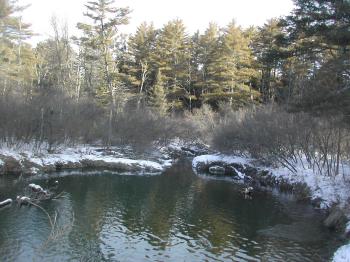
On a recent morning, Betty Williams stood on the campus of the University of Southern Maine near the headwaters of Tannery Brook. From there, she watched the water flow calmly between the hemlock clustered at the banks, just as it did 200 years ago.
“It’s a gem,” Williams said of the brook.
However, that same description cannot be applied to the entire length of the brook. Farther downstream, it needs some attention. The banks are eroding, and contaminants are running into the water, washed from the impervious surfaces of Gorham Village.
Williams has been working on cleaning up portions of Tannery Brook for some time. She was the project manager for the Tannery Brook Watershed Management Plan that was prepared by Cumberland County Soil & Water Conservation District. The plan, which was aimed at making water quality improvements, was spawned when the brook failed to meet state standards in 1999. Williams and her team devised a plan to reverse years of pollution and neglect and restore Tannery Brook to its former pristine condition.
“There’s a potential to bring it back,” she said.
Williams said the plan is to clean up the brook now, but also to maintain the water quality in the future so the brook doesn’t degrade again. “The management plan is a guide to help future protection efforts of Tannery Brook,” Williams said.
Pollution problems
From Alden Pond, the brook flows for more than four miles through Gorham into Little River. The brook flows under School Street near the site where Hugh McLellan molded clay into bricks to build his house more than two centuries ago.
Old-timers knew the upper part of the brook as Tommy’s Brook. Once a natural habitat for trout, water quality problems and a dam downstream have killed the fishery there.
“There should be trout” here, Williams said.
While Williams said Tannery Brook’s headwaters now meet water quality standards, the water quality deteriorates as the brook passes through Gorham Village. Williams said the “huge” runoff from the village erodes the brook’s banks and warms its waters.
“It’s the volume that creates problems,” she said.
An increased number of houses and more paved areas that result from that development are the cause of the elevated storm water runoff. There are now nearly 500 homes along with a number of businesses in the Tannery Brook watershed, which covers almost three square miles in Gorham. Tannery Brook is also part of the Casco Bay watershed.
The brook’s water quality has the attention of the town, which supported developing the management plan, and the state.
The plan identifies erosion areas that affect the brook. Several erosion sites on Fort Hill Road will be repaired when the road is reconstructed this year. Additionally, Williams said the Gorham Public Works Department has been working to stabilize storm water outlets in the village.
“The town has been a good partner,” Williams said.
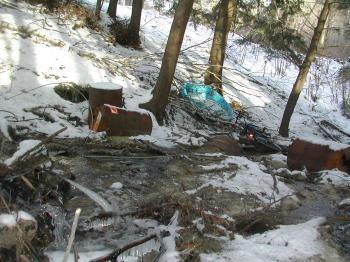
Williams is also hoping volunteers from the town and an environmental class at the university could partner to clean up the trash, which includes metal barrels, a bicycle and some cables, in a tributary of Tannery Brook behind the village. The trash lies in the stream bed off Glenwood Avenue, and Williams heard that kids had once built a bridge using the barrels.
“It would be really nice to get this cleaned up,” she said.
A gift to appreciate
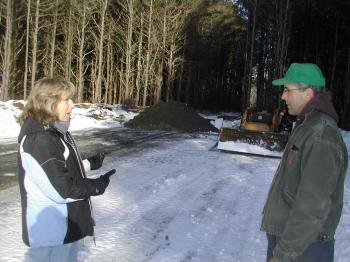
The public can access the brook through the Tannery Brook Park off Gray Road. Gorham Savings Bank gave the land to the town a few years ago. “They were very generous,” said Dale Rines, chairman of the Gorham Parks and Conservation Committee.
The park is right in the center of town. It was once Harley Day’s cow pasture. Once the land was purchased by Gorham Savings, the bank built homes on some of the land and allowed pine and spruce trees to grow on the remaining land in the 1960s.
Rines said the committee is continuing the tree management practices that started when the bank owned the land. Rines said the Town Council approved a plan allowing the committee to transform skid roads through the woods into walking and hiking trails. He said the committee, which has a limited budget, depends on volunteers to do the work.
Snowshoe and snowmobile tracks show evidence that the trails through the park are being used. Town Manager David Cole has been cross-country skiing and snowshoeing there this winter.
“It’s the kind of gift I think the town will appreciate in the future more than they do now,” Cole said.
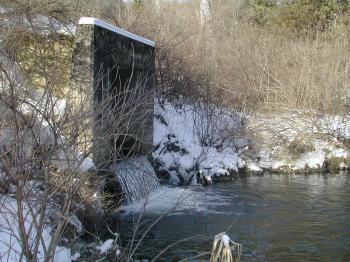
The town is also considering what to do about an old dam that partially impedes the flow of Tannery Brook. The dam was built across the brook in the 1950s for agricultural purposes, creating a four-acre pond. It blocks fish from traveling upstream but Williams said the pond is a “great habitat” for birds.
Decades ago, the town removed the gates from the dam because septic systems in the village leached into Tannery Brook and into the pond. “Before Gorham Village had a sewer system, things were pretty ripe down there,” Rines said, but he added, water quality has improved a lot in recent years.
While the gates are gone, nature has contributed to holding back the brook, as beavers have built their own dam between two concrete abutments through which the brook flows. The town is undecided on whether to restore the man-made dam or remove it.
The Tannery Brook Watershed Management Plan got financial support from a Department of Environmental Protection grant. The Town Council and planning boards have copies, and the plan can be viewed on line. Gorham’s Web site has a link to it at www.gorham-me.org.
One goal of the study was to raise public awareness. “It has generated a lot of interest,” Williams said about the recently released plan.
For more information, call the Cumberland County Soil & Water Conservation District at 856-2777.
 (tannery brook 1)
  (tannery brook 2)
  (tannery brook 5 or 6)
  (tannery brook betty, dale)
  (tannery brook 7) – Betty Williams views Tannery Brook from the campus of the University of Southern Maine. ‘It’s a gem,” she said about the little known brook.
Send questions/comments to the editors.
