



During Maine’s often stormy winters, the occasional power outage is a fact of life. But what happens when power is cut short, not due to fierce winds or inclement weather, but through a controlled power outage known as a rolling blackout?
All six states on the New England power grid have been warned that the region may face “rolling blackouts” if sudden cold temperatures spike demand for electricity. And the American Red Cross has issued an advisory warning telling homeowners and businesses to be prepared.
Rolling blackouts, where areas in a power grid are intentionally and temporarily shut down, are conducted to prevent the grid from peaking over capacity. If the grid does peak capacity, it could jeopardize the integrity of the grid, and power outages could occur without control.
With the heightened risk of rolling blackouts posed this year, all New England states are taking measures to prevent these controlled outages.
Perhaps you’ve seen the public service announcements on television: a woman sits in her living room chair watching the news. She turns off unneeded lights and saves energy. These public service announcements, along with a companion “Efficiency Maine” public service campaign informing customers that if they reduce their energy needs they could win a $1,000, are aimed at persuading consumers to conserve.
They inform viewers that the shortage of natural gas caused by Hurricane Katrina is putting strain on power generation. What they don’t tell viewers is that the increased demand on the grid could force the regional power controller – in the Lakes Region’s case Central Maine Power – to issue a rolling blackout.
In a rolling blackout, utility companies temporarily shut down locations on the power grid for typically an hour. After that time, power is restored to those locations and shut down in other neighboring areas. This goes on until demand is reduced and stability is regained in the power grid.
On Jan. 19, Portland Water District shut down power to its treatment and pumping stations in Standish as an emergency test issued by the Independent Service Operator of New England, a non-profit company that controls the six-state power grid.
The water district and other Maine companies have voluntarily agreed to reduce their power loads by 70 percent to curtail the need for a rolling blackout when the ISO issues “power warnings.” In exchange, these companies receive monetary compensation, the equivalent of one month worth of free electricity, says Michelle Clements, spokesperson for the water district.
Even with the pumping station fully shutdown, the water district has 25 million gallons of water in reserve to service the Greater Portland area. In times of sustained emergency, several megawatt generators are on hand to keep public water in operation.
The Maine Public Utilities Commission recommends that homeowners make the same conservation efforts, especially during peak hours. The commission recommends delaying energy-heavy activities such as washing laundry and dishwashing until after 8 p.m., replacing bulbs with energy efficient ones, keeping the thermostat down low and turning off unneeded lights.
“This year in the wake of Hurricane Katrina, the ISO of New England has expressed concern that if there are some cold snaps, the supplies of natural gas might be constrained and there might be some electrical generation issues,” said John Sukaskas, senior engineer at the Maine Public Utilities Commission. “Conservation throughout the region is something we all can do to minimize the likelihood of (a controlled power outage).”
Rolling blackouts left much of California in the dark in 2001 when demand peaked the grid and a succession of rolling blackouts was needed to restore its integrity.
On the New England grid, there are 6.5 million households and businesses with more than 8,000 transmission lines and roughly 32,000 megawatts of total supply. The all-time high for demand occurred last July at 26,921 megawatts.
While the most heavy use of electricity is in the summer, even in Maine, the cold winter months in New England apply pressures to the grid. They reduce supply of natural gas as homeowners and businesses turn up the heat.
“(Cold weather) raises the demand for natural gas and oil and reduces available supply for electricity. And demand for electricity rises to double peaking for demand,” said Ken McDonnell, spokesperson for ISO of New England.
ISO New England, McDonnell says, is keeping a keen eye on the grid and the weather forecast. If a extreme cold front is due to move in across the Northeast and a rolling blackout is needed, news outlets and the Governor’s office will be informed to get the message out. Also, the ISO has recently instituted emergency procedures to switch some natural gas power plants to oil if need be.
“If we see that a major arctic blast is due to hit us in three or four days, we can take measures now to get some of the gas-powered plants ready to switch to oil while securing as much natural gas as they can,” McDonnell said.
The American Red Cross has issued advisory warnings with tips to keep warm and safe in case of rolling blackouts such as keeping bottled water and canned food in the house as well as a portable radio, and a flashlight handy. If the power does go out, keep doors and windows closed to contain heat in the house. Power outages leave all residents vulnerable who rely on electric furnaces for heat.
If these power outages are sustained for a substantial period of time, the Red Cross will send out volunteer teams to set up shelters in coordination with the state emergency agency.
Local hospitals like Maine Medical Center and Bridgton Hospital have emergency generators to power their facilities and see no interruption in service when the power goes out.
“It’s always a little disconcerting when you’re running your generator,” said John Carlson, president and CEO of Bridgton Hospital. “But we exercise and service our generators on a regular basis.”
Some schools also have generators ready in case of a power outage. While the Windham school district only has one generator, located at the high school, teams of faculty at every school are trained in emergency procedures and would direct students to the power-generated areas. These teams also have walkie-talkies to communicate internally in case of a power outage.
Aside from the natural gas shortage, the risk of these rolling blackouts has increased in recent years due to growth and increased demand, says the ISO. And soon, new power plants will be needed to keep pace with New England demand.
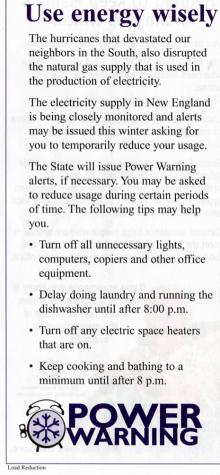 This flyer was added to customers’ Central Maine Power bill for January. It warns that rolling blackouts could be coming because of low natural gas supplies.
 Send questions/comments to the editors.
