



Windham artist/poet/musician Louis Sinclair is modest about his accomplishments.
As a painter, his career took off during a long sojourn in Ireland and success followed him home to Maine. As a musician, he’s played at venues throughout the state and been featured on Maine Public Radio. As a poet and writer, he has been published in several literary journals, written opinion pieces for the Boston Globe and New York Times, and had poems included in a book published by the Maine Arts and Humanities Council.
Still, Sinclair, 62, was surprised to learn last month that he would be included in the new edition of “Marquis’ Who’s Who in America” – a reference book comprised of short profiles on America’s greatest living leaders. Within the pages of “Who’s Who” released in November, Sinclair is featured among American icons like astronaut Neil Armstrong and historian David McCullough.
Though Sinclair’s life is truncated in the reference book, it has been a life filled with adventure, heart and passion for the arts. A friend nominated him for the Who’s Who publication because of Sinclair’s wide-ranging talents, passions for the arts and humanitarianism.
“Painting and music and poetry have always been first loves,” Sinclair said. “It’s been hard to separate them.”
Sinclair sees the three arts as interwined. There is poetry in painting, he says. Poetry in music. Music in painting and so on. For example, the “slow airs” of Ireland evoke an amazing pictoral quality, he says.
An artistic heritage runs through Sinclair’s family. His parents met while painting watercolors and Sinclair himself learned the craft as an apprentice in his uncle Louis Roberts’ studio.
Though he became involved in the Maine poetry community before pursuing painting professionally, Sinclair said his main focus has always been art.
After returning from military service and attending college at University of Maine in Augusta, Sinclair resettled in Dublin, Ireland in 1973. His eyes had been badly injured while keeping peace in Korea and hoped the moist climate of Ireland would provide relief. There he became involved in the artistic community and found fellowship through the Dublin and Ulster Arts Clubs.
Sinclair began painting surrealism in oil and watercolors and, over a course of years, turned more toward “magic realism,” a style that was becoming popular at the time.
“My surreal paintings were not dark. I tended to blend more humor into them. I think it may have been a way to deal with the trama of war,” Sinclair said. “For me, one of the exciting things was to take realism to another level, to the level of surrealism or abstraction.”
Sinclair’s works were first exhibited at the Oliver Dowling Gallery in Dublin and later at the Royal Hibernian Academy, National Gallery of Ireland and various others. While in Ireland, Sinclair was inspired by “urban landscapes” and spent four years painting old shop fronts in Dublin. The city was going through a “modernization” at the time so Sinclair had to work quickly on some shop fronts because they were scheduled for demolition.
Sinclair returned to Maine after being invited to exhibit at the Farnsworth Museum in Rockland in 1981. He has since exhibited throughout Maine including the Maine Biennial at Bowdoin College in Brunswick.
While his paintings often revolve around these urban landscapes, his poetry addresses man’s relation to nature.
In a poem entitled “Migration” published in the Onion River Review in fall of 1993, Sinclair describes nature’s winter migration. The last stanza of the poem reads:
“red stars explode unseen recessed in the sky
an orange comet’s tail streams and burns and dies
for birds musicians to poets ears beat south now
tongues chatter to the wind of losses gains again.”
Along with his artistic accolades, Sinclair has undertaken many humanitarian endeavors. During the 1980s, he fought to get federal grants for homeless shelters and talked legislators into creating the first central Maine shelter. In 1993, he worked to relocate children from war-torn Bosnia.
For Sinclair, community service is something that has given him a “wholeness” and fed his spirit and his work.
“I don’t think we can consider ourselves part of a community unless we reach out in some way,” Sinclair said. “It doesn’t have to be a colossal effort. Just helping one or two people can make a difference.”
Sinclair does less painting nowadays because of his eye problems and has concentrated more on writing and music. He’s learning to master the “Hurdy-Gurdy” as of late – a French bowed-stringed instrument played by turning a crank – and is excited to see his son Owen bloom as a musician as well. He is also working on a print series of Irish shopfront paintings and a memoir that will include original poems and short stories.
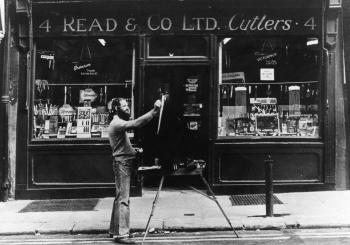 Artist Louis Sinclair paints the Read & Co. Cutlers shopfront in Dublin, Ireland. Sinclair, who was recently included in “Marquis’ Who’s Who in America,” took a long sojourn in Ireland where his work is still widely exhibited.
 Send questions/comments to the editors.
