



Thousands of racers are packed onto a thin strip of pavement behind an arch of green and white balloons spanning Ocean House Road. Speakers blast music as runners sprint up and down the street to get loose. A loudspeaker announces the start of the wheelchair race in two minutes, which will start five minutes before the larger race.
Mary Ann Doss, coach of the Cape Elizabeth girls’ cross-country team, stands in the crowd before racetime. She attempts to stay calm, confident and focused. But that doesn’t stop her from chatting with the friends surrounding her. “I ran in college,” she says. “I just do it for fun now.”
Down the road in front of the Inn by the Sea, three long wooden tables lining each side of the road mark mile one. The tables hold two tiers of small, green Poland Spring cups full of water. Cherie Tate of Scarborough stands alongside one of the tables. “We have 5,000 runners, so hopefully we have 5,000 cups,” she says.
As the minutes tick closer to the expected start time, the yellow-shirted volunteers prepare to receive the thousands of runners they will soon see come into view as they round the corner of Ocean House Road. Some know what to expect.
“I’m expecting to get wet,” Tate says.
Kathryn Smith stands alongside yellow-shirted volunteers in a red medical staff vest. A list of the possible injuries she could encounter runs through her head: heat exhaustion, sprained ankles, knee problems, diabetic emergencies. This is the first time Smith, an EMT in Cape Elizabeth, is volunteering her time at the Beach to Beacon. But, she is not nervous; she will be ready to react to any given situation.
“It probably won’t be a problem at mile one,” Smith says. “It’s more dangerous as the runners near the end of the race. Up here, I’m not sure how much we’ll see.”
A half-mile past mile one, Carl Dittrich stands outside his home with a few friends with the Grateful Dead wafting from a boombox set up on a table. A green hose snakes across his yard toward the road, climbs a utility pole and reaches out across a wooden arm. The hose has a showerhead attached to the end and a sign announces the “Shower of Power.”
Every year Dittrich sets up the “Shower of Power” for the runners, and they love it, he said. He estimates about 500 to 1,000 runners pass under the shower. Many of them swing onto the shoulder specifically to run under it, Dittrich said.
The runners can hear the music before they round the corner and reach mile five. “It’s no jive, you’re at mile five,” the banner spanning the racecourse at the head of Lawson Road reads. The ubiquitous little Poland Spring water cups cover several tables along the roadside.
Music is blasting from another radio and Patty Grennon stands ready to pass out water and get a little wet in the process. “It’s always a toss-up,” Grennon says, whether to run in the race, which she has done three times, or volunteer.
Howard Littlefield, who lives right on the corner, organizes the volunteers at mile five every year. Volunteers and neighbors gather in his yard for a potluck breakfast in the morning to get excited for the race. At the first Beach to Beacon eight years ago Littlefield stretched the banner across the road and played music for the runners. That year mile five won the first place prize for best water stop, a competition no longer held. Littlefield estimates they pass out about 120 gallons of water in 8,000 of the little green cups.
Two hundred and seventy-eight of those water-filled cups were passed out by three young and eager volunteers this year. Fourteen-year-old Helen Gillis of Cape Elizabeth, her 12-year-old sister Nona Gillis and 13-year-old Ali Clopton, a longtime summer resident, competed this year to see who could pass out the most cups. The scores mounted slowly at first, but Nona, the youngest, gained the lead early. She kept the lead for the duration of the race, finishing with 109 water-filled cups being passed out against 85 and 84 by Helen Gillis and Clopton respectively.
In Fort Williams Park a yellow upside-down, fan-powered windsock marks the spot where results are posted following the race. Large groups of runners stand three deep scanning the long list of printed names and numbers.
“Victory blossoms can be bought beneath the blue tent,” the loudspeaker announces.
Among the crowd gathered at the results a man in a white tank top talks with a friend about their race times. The back of his shirt has the name “Peter Cooley” printed on it and the years “1965 – 2004.”
Scott Richards ran this year’s Beach to Beacon in memory of his running partner, climbing partner and friend Peter Cooley. Cooley and Richards used to train and race the Beach to Beacon side by side every year. But, in May 2004, when Richards and Cooley were climbing Mount Rainier in Washington, Cooley fell and suffered a serious head injury. Richards stayed with his friend for two days on the side of the mountain while they waited for rescue. Cooley died in helicopter on the way to the hospital.
“I’ve lost a little bit of my intensity,” Richards said. “I miss him.”
Because he has been focused on grieving Richards hasn’t been training very hard, but he said next year he would be more prepared. “I run with his energy,” Richards said. “He loved this race.”
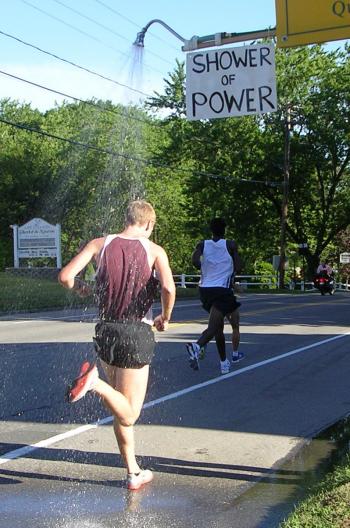 Carl Dittrich’s “Shower of Power” offers a refreshing break for the runners.
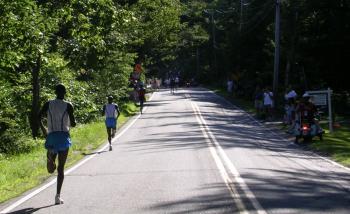 Elite runners in the Beach to Beacon race towards Fort Williams Park along Shore Road.
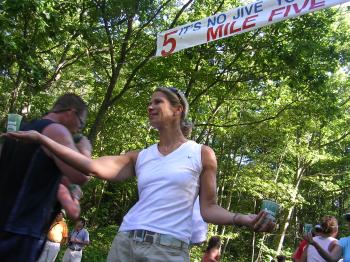 Patty Grennon stands at mile five with water for the runners.
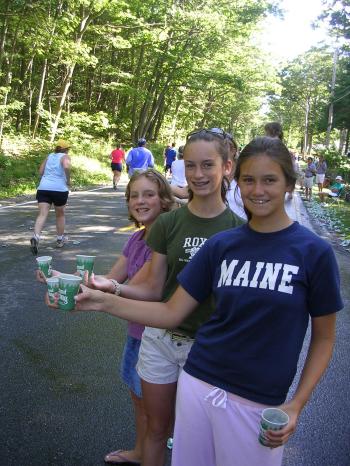 From the left, 12-year-old Nona Gillis, her sister Helen Gillis, 14, and 13-year-old Ali Clopton stand ready to see who could pass out the most cups of water. Nona took the glory by passing out 109 cups of water of race day.
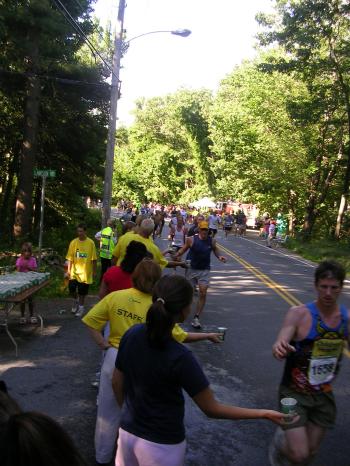 Runners come around the corner at mile five and grab for the water before the last stretch to Fort Williams.
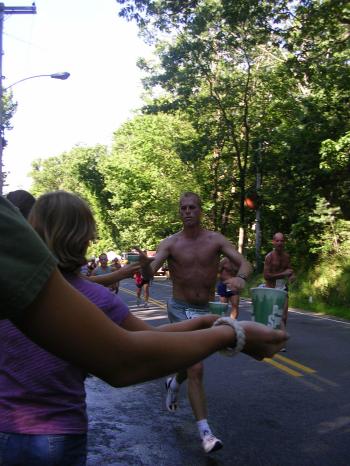 A runner grabs a cup of water from a volunteer at mile five.
Send questions/comments to the editors.
