



Labor organizer Carl Leinonen of Scarborough understands the labor movement needs more than old-time rhetoric and organizing practices that were successful 50 years ago. That is one reason why he supports the Service Employees International Union’s split from the AFL-CIO this week.
Leinonen was the executive director of the Maine State Employees Association, a chapter of the SEIU, for 16 years. Today he works with the national organization working on creating partnerships with international unions. The job has him routinely traveling to Eastern Europe and in between visiting SEIU’s Washington, D.C., headquarters.
The SEIU, which focuses on health care, public service and property service employees, has been the fastest-growing union for the past 10 years. It has 1.8 million members and has gained 100,000 members since the beginning of the year.
One reason for the union’s increasing membership is that it is not afraid to take new approaches to organizing and try new strategies to increases its strength.
“The leadership has always been creative; they are not afraid to fail,” Leinonen said.
One example of the organization’s creativity is its work outside of the country. In today’s global economy, with multinational companies employing hundreds of thousands of people in dozens of countries, it is no longer enough to only organize those living in America.
Leinonen said in order to be effective a union cannot just organize in one shop within a company that has 30 shops around the nation.
The same principle works for multinational companies, he said. In order to achieve their full power, American unions should form partnerships with their foreign counterparts and provide a united front in helping to improve working conditions for all the people employed by that company.
“You have to be able to have effective leverage to get their attention,” he said.
He describes his job as identifying where the union needs to go, whom to work with, making connections with his foreign counterparts and seeing if some common ground can be found. Sometimes this is done through union-to-union contact, other times through one of the various international union organizations.
But it is not an easy job, especially with the complexity of dealing with another country, its cultural differences, language, laws and political environment. In fact in some countries there are several unions representing one particular industry.
“It’s very very tricky figuring out how to make it happen,” Leinonen said.
Currently Leinonen is focusing his work on India and Eastern Europe. Poland has been chosen as the first country that the SEIU will focus on and Leinonen will soon visit the country for a crash course in the language.
He said a good portion of the foreign work would focus on the property services union, which includes building maintenance people, security guards and others who work to ensure buildings are running smoothly.
This is because of a recent consolidation within the industry, creating a handful of large multinational companies that employ hundreds of thousands of people.
Another reason for the SEIU’s increased focus on international companies is because many employ people in America. These companies are so large and common they even employ people here in Maine.
For example, First Student, an American subsidiary of First Group, a British transportation company, employs Augusta school bus drivers. Another example can be found with some security workers at the Portland International Jetport and Riverview Psychiatric Center in Augusta, who are employed by Securitas AB, a Swedish company with operations in more than 30 countries.
“Just look around our own economy. It’s not out there, it’s here,” he said.
Unions and the protection they provide for workers is an issue important to Leinonen and one he learned first-hand as a child.
During his childhood Leinonen’s father passed away, and his mother sold the family’s egg farm in Waldoboro and moved in with his grandmother in Quincy, Mass.
His grandmother was a seamstress and a union activist for the International Ladies Garment Workers Union and first introduced him to unionism.
“I learned a lot from her, her enthusiasm and the differences it made in her life,” he said.
The union also had an effect on his life too. Because of the higher wages and other benefits provided through her union contract, his grandmother was better able to provide for him, his mother and his two siblings.
“That made the difference in her life and I came to appreciate the differences it made in my life as well,” Leinonen said.
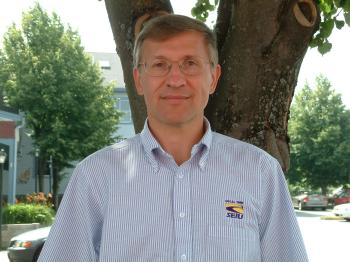 Carl Leinonen
Send questions/comments to the editors.
