



Girls Kick ALS is a demonstration of true friendship – something Darcy Wakefield said she has gained a real appreciation for since being diagnosed with ALS, a disease that attacks the nervous system, in late 2003.
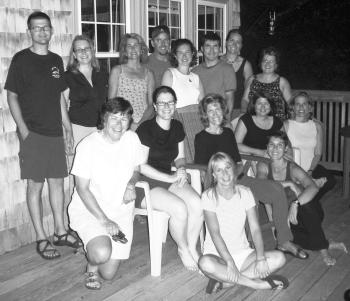
Friends of Wakefield, a Cape Elizabeth resident, formed Girls Kick ALS in early 2004 to raise money to cover some of the costs associated with living with ALS. The friends came together from different aspects of Wakefield’s life – her cooking group, her book club, old friends, colleagues and family – but Amy Wood, a founding member of Girls Kick ALS, said they all share one common goal, to do “anything we can to make life more comfortable for Darcy.”
And they have: To date Girls Kick ALS has raised $21,500, which has purchased a beach wheelchair for Wakefield, an avid beach runner before her diagnosis; a page-turner device to help her read; and the cost of supplies for the construction of a porch and ramp to make her home wheelchair accessible.
They have held fund-raising events ranging from a rummage sale in Cape Elizabeth to a show at the Theater at Monmouth and have participated in the national Hike4ALS in the Camden Hills. Southern Maine Community College, where Wakefield was an English professor before her diagnosis, also raises money every year with the Darcy Wakefield Fun Run.
“Having ALS has made me more aware of how important family and friends are,” Wakefield said. “Sometimes it is easy to forget that.” Her friends visit her often: They take her out, they read to her.
“All my friends have been really supportive,” Wakefield said. “It’s really incredible, all that they’ve done.”
ALS is a disease that attacks the nerve cells in the brain and spinal cord, destroying the ability of the brain to control the movement of the muscles within the body. While the person eventually loses all ability to control their body their mind remains unaffected. The disease is most commonly referred to as Lou Gehrig’s disease, but it drives Wakefield crazy when people call it that.
“First of all, I imagine he’d rather be known for baseball than for what he died of,” Wakefield said. But also, “it really erases the fact that a lot of women get the disease.”
Wakefield likes to call ALS “an equal-opportunity disease.” An estimated 30,000 people in the United States have ALS at any one time, according to the ALS Association’s Web site. Though the disease affects men 20 percent more often than women, those numbers balance out with increasing age. Little is known about the causes of the disease and there is no cure. Half the people die within the first five years after diagnosis. ALS is always fatal.
“One thing I can’t stress enough is how important it is to find a cure,” Wakefield said. Within the last year the disease has deteriorated Wakefield’s speech to such an extent that a friend was necessary to translate during the interview.
The disease has also taken away Wakefield’s ability to run and write, two things many people take for granted, and were defining characteristics of who Wakefield was before her diagnosis.
“Darcy always went out of her way to be very healthy and very active,” Wood said.
When Wakefield first began having problems with her right leg and foot she was training for the Beach to Beacon 10K road race in Cape Elizabeth. At first she thought it was a sports-related injury and treated it like one. She iced it and stretched more, but to no avail.
It was an examination by a neurologist friend that first gave an inkling it could be much more serious than a sports injury. Wakefield still kept hope and researched all sorts of possibilities of what it could be, anything other than ALS. At one point she held out hope that it was Lyme disease.
“It is surprising what diseases look appealing after I had ALS,” Wakefield said.
When she did receive confirmation that it was ALS, she was sitting in an empty classroom at SMCC speaking with a specialist from Boston she had seen the day before. At the time she “was really, really overwhelmed.” She doesn’t have words to describe how she felt at that moment.
“When you get a diagnosis like mine nothing prepares you for it,” Wakefield said.
Wakefield took medical leave from her job and wrote every day. It was during the months following Wakefield’s diagnosis that she wrote the majority of essays now contained within her new book “I Remember Running: The Year I Got Everything I Ever Wanted – and ALS,” scheduled to be released in October.
“The writing was very helpful,” Wakefield said. Before her diagnosis she tried to write every morning, but she often “blew it off” to go running, grade papers or clean her apartment. But, she said, “there was a real urgency to write more after my diagnosis.”
And Wakefield hasn’t let the fact that her hands are no longer cooperating stop her from writing. She types with a device that tracks her eye movements and says she writes about eight hours a week. She has already completed five additional essays for a possible future book.
The title of her book “I Remember Running: The Year I Got Everything I Ever Wanted – and ALS,” refers to the happy events in her life the same year of her diagnosis. Following her diagnosis her partner Steve moved from Colorado to live with her and she became pregnant with their now-ten-month-old son Sam.
Because of ALS Wakefield can’t hold her son as much as she would like. Only near the end of the day when Sam has tired himself out and is done squirming all over the place can Wakefield safely have him in her lap.
“Having Sam has been a real incentive to be in a good mood,” Wakefield said. “There are really hard days,” but when those days arrive she tells herself that it won’t be hard all the time.
She used to be busy all the time, but is now grateful for the small things in life she never allowed herself to notice before. “The biggest thing I’ve learned is the importance of living in the moment,” Wakefield said. “And that’s something I’ve never been very good at.”
 no names yet
Send questions/comments to the editors.
