



Along the coast of Maine runs a series of banks and ledges where the ocean floor rises to create a shallower ecosystem than the surrounding ocean – an ecosystem that scientists and other observers such as fishermen and whale-watch vessel operators know attracts a variety of marine predators.
These predators roam widely looking for favorable feeding conditions and when they find one an intricate food web is created where seabirds, whales, dolphins, tuna and sharks feed on the herring and other fish, which are there to feed on the abundant populations of krill and plankton.
These feeding frenzies become known as “hotspots” by scientists and prime fishing grounds for commercial and recreational fishermen.
Scientists would like to known more, however, about what is physically happening in the ocean during these times of high predator activity and high species diversity, what physical conditions are making the area favorable for feeding and what is happening when the predators leave.
A group of scientists from the University of Southern Maine and the New England Aquarium hope to answer these questions using Platts Bank, approximately 34 miles off the coast of Cape Elizabeth, as a sampling area.
The study is being conducted this month with a minimum of ten visits to the bank, which measures about ten by nine miles and is 173 feet deep at its crest and surrounded by water 330 to 680 feet deep, in the research vessel Galatea.
A spotter plane is also conducting aerial surveys to assist in the study and help lead the boat to any major feeding “hotspots.” The study is privately funded by the Sloan Foundation.
The research vessel spends the entire day at Platts Bank observing and recording different aspects of the ecosystem, from population levels to salinity, with various scientific measuring apparatus. Observers are also there to record the feeding activity the researchers are observing.
Heather McRae, a researcher on the project, described a “hotspot” observed earlier this month in a journal entry:
“Herring are breaking the water’s surface, jumping and twisting to feed on dense patches of krill and calanus copepods. Like popcorn, the krill jump into the air as the herring attempt to have dinner. On the edge of these frantic patches a humpback whale lunges from below the surface with its accordion-like ventral pleats fully expanded.”
Lewis Incze, a research scientist at the University of Southern Maine, is heading the study along with Scott Kraus from the NEA and Peter Stevick, another research scientist at USM.
Incze said the study’s main area of inquiry is around the question of “what is occurring at these banks that make them hot or cold at a particular time?” Is it because a keystone species such as herring is driving the changes with its transitory visits? Is it because the predators ate everything and moved on? Is it for oceanographic reasons? These are all questions that scientists hope to answer during the month-long study.
“I think herring have a major role in this,” Incze said. The researchers have already been able to observe and study some “hotspots” at the bank and have been collecting valuable data.
“To some extent we were lucky,” Incze said. It was possible the scientists would study the bank for a month without finding any “hotspots.”
The study is focused on short-term patterns during a single month, but Incze said proposals for further study would be made.
Incze said the results of the study will be released in various forms, mostly in scientific papers that will filter down to the people who will use the knowledge. He said the fishing industry is interested in these types of studies because it helps them understand the Gulf of Maine ecosystem better.
‘The industry doesn’t like to be regulated unfairly,” Incze said, so any increased amount of understanding of the ecosystem or marine populations can help. But, Incze is careful to point out that this study is looking at natural processes in the ocean, not the fishing industry.
“We’re not there to make any assessments that are regulatory in nature,” Incze said.
“We’re all better off understanding our ecosystems,” Incze said. The more we understand them, “the more effectively we can use them sustainably.”
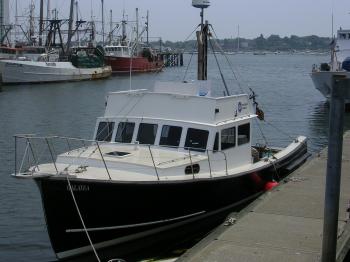 The RV Galatea sits at a dock at the Gulf of Maine Research Center.
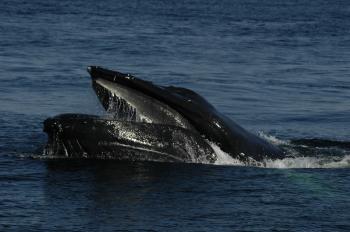 A whale feeds at Platts Bank, where researchers are studying the ocean ecosystem.
Send questions/comments to the editors.
