



Why are there so few sailboats on Maine’s second largest lake?
Raymond resident Hal Bumby doesn’t have an answer to that question. But he’s doing what he can to change the situation.
Last summer, Bumby, who lives along Turtle Cove, off Shaw Road on Raymond Cape, started the Sebago Lake Sailing Club. He bought a number of used Laser II and Optimist sailboats for the club, leasing them to individuals who agreed to participate in weekly races on the lake.
With the help of his son, Colin, who organized the races and assisted its participants with their boats, Bumby grew the club from its original three members to 14 by the end of the first season.
This year, Bumby is excited about another season of racing, but, with his hectic schedule as a business owner, admits to being unsure why he has undertaken the project. “I’m one of those shy people,” he said. “I’m a doer but I don’t feel like I’m meant to be.”
Although he may be shy, Bumby’s passion for the sport belies the fact as he talks enthusiastically about the joys of sailing. He relishes the tranquil silence inherent in the activity and the way that silence enables him to glide up unnoticed alongside a loon or other wildlife. He enjoys the actual operation of the boat and the relationship it has with both the wind and water.
But Bumby’s infatuation for sailing spills over, exposing his competitive nature, when he talks about racing these crafts. “Racing is like playing chess,” Bumby said, “but is athletic at the same time.”
And this combination of analytical skill and athleticism excites him – especially when racing his newest acquisition.
This year, Bumby has purchased one new and one used Melges MC scow to add to his collection. Scows are racing sailboats, especially popular in the Midwest, that have a rich history in the Lakes Region area. An older version of the scow, called a canal boat, was used to carry logs from Long Lake, down Sebago Lake, and through the canal to Portland.
Today’s scow is designed for speed, with a flat bottom, rounded bow, and double bilge-boards. It heels far over to the side, reducing the wetted surface area, which results in greater speeds.
Scows are manufactured in five basic classes. Class A, which takes a seven-man crew, is the longest at 38 feet. The C Class, at 20 feet, takes two to three people. Class E is 28 feet long, with a crew of three to four. And the MC, Bumby’s model, is 16 feet and takes one or two people.
There are strict rules to follow when setting up the buoys for a race. According to Bumby, the course is triangular with each of the three legs a mile in length. Racers navigate the course twice, for a total of six miles. Sebago Lake offers additional challenges when setting a course. Because the lake is so deep, the ropes connecting the buoys to the anchors must be extra long.
Although Bumby is an avid sailor, his wife, Patty, has no interest in the sport. “My wife wants me to see if any of the towns’ rec programs would be interested in getting usage from, if not gifted with, the sailboats,” he said.
While Bumby’s wish is to continue to host the club and teach young people as well as adults to sail, he is frustrated by his lack of time.
But, for this year at least, he plans to resume the club’s activities for the summer months. The first meeting will be 9 a.m. on Saturday at his home. Attendees will discuss dues, racing and party schedules, boats, and other related topics. The first race is scheduled for 1 p.m. in the afternoon and races will continue weekly on Saturdays through September.
“If you own a sailboat, join us,” said Bumby. “Racing is fun and helps improve everybody’s skills. If you don’t sail but think you might enjoy starting, join us – we have extra boats. If you just want to watch, join us as we need officials to run the races.”
For more information, call Bumby at 655-5264.
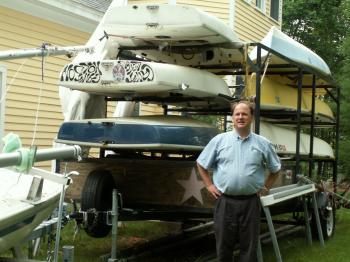 Hal Bumby stands in front of the Sebago Lake Sailing Club
Send questions/comments to the editors.
