



Three large windrows of yard waste in varying degrees of decomposition wrap around a grassy hill at the back of the Cape Elizabeth Transfer Station.
The windrows terminate in an open area where a green machine sits resembling a large insect with a metal-screen cylindrical body and a long thin dragonfly tail of a conveyor belt.
It is a Trommel Screener, the machine Mark Butterfield uses to screen the organic matter that has been composting at the transfer station for almost 18 months. Butterfield is the manager of the garden division at the William H. Jordan Farm, which pays the town $1 a year to handle the town’s composting.
Cape residents can come here, drop off their bags of grass clippings and other yard waste and leave knowing that in time those leaves and grass clippings will be dark, rich organic matter ready to use as compost for their gardens. Butterfield said more leaves than usual have been dropped off this year and he is worried he will run out of room.
Since 2000 the composting operation at the transfer station has made this form of recycling available to the community. Originally managed by Scott Collins, the operation was taken over on Feb. 21 by the William H. Jordan Farm. They sell the finished compost under the name inherited from Collins, CE Compost, at their farm on Wells Road or by delivery.
Contrary to what some assume, the “CE” stands for “Clean Earth” rather than “Cape Elizabeth.” But Carol Anne Jordan, head of garden division operations at the Jordan Farm, said it doesn’t matter, everybody just refers to it as “the dump stuff” anyway.
The garden division at the farm was started as an attempt to diversify the Jordan Farm’s operations. The catalyst behind the garden division at the farm was Butterfield, the grandson of William H. Jordan Sr., who began running the farm in 1948.
In fact, most of the family is now involved with the farm. William H. Jordan Jr., began working with his father on the farm in 1972 and now runs it. His three sisters, Penny, Carol Anne and Pam (Mark Butterfield’s mother) have all begun working at the farm in recet years.
Diversification is the bottom line of any business, Carol Anne Jordan said. So when Collins, the previous manager of the composting operation at the Cape Transfer Station, decided he wanted to spend more time with his family the Jordans saw an opportunity.
“The time was right for him. The time was right for us, so we went for it,” said Butterfield.
Butterfield tends to the daily management of the operation, including driving around in a front-end loader, turning the windrows to keep the temperature high and help speed decomposition.
The newest pile is the largest and longest, with brown paper yard waste bags and green grass clippings still visible. This pile needs to be turned the most often; Butterfield does it once every couple of weeks to keep the temperature in the middle at about 135 degrees. After nine months of constant turning Butterfield transfers it to the middle windrow. By this time the compost is fairly broken down and the temperature in the center is much lower; green grass clippings and brown paper yard waste bags are no longer visible. The decomposition has also shrunk the pile’s volume.
The third windrow has been sitting there for almost 18 months. It is fully broken-down compost and has only one more process before being ready to sell back to the residents of Cape Elizabeth – to go through the belly of the Trommel Screener.
The trash that people put in their bags of yard waste is surprising. “Out of sight, out of mind,” Butterfield said. A pile of rocks, wood, chunks of metal, tennis and golf balls, plastic bags and plastic bottles builds up at the cylindrical end of the screener. On the other end a pyramid of dark, organic matter ready for gardening accumulates at the end of the conveyor belt. The combination of decomposing matter and mud makes it smell like a cow pasture.
The Jordan Farm pays about $4,000 a week to rent the machine, but when the compost is wet it can’t be screened. For the past couple of weeks it has rained and rained and rained, and the Trommel Screener has sat idle at the Cape Elizabeth Transfer Station. With dry compost the screener turns out 80 to 100 cubic yards of fine compost an hour, Butterfield said.
However, if the compost is wet, which most of it is when Butterfield can find a dry day to screen, he can only produce about 40 or 50 cubic yards an hour. He will be working non-stop for the rest of the month attempting to get enough compost screened and ready to satisfy the steady stream of local landscapers and home gardeners the Jordan Farm expects through the end of June.
The CE Compost can be had for $29 per cubic yard at the farm on Wells Road, as well as other types of mulches and compost: dark bark mulch, topsoil and “gardener’s gold,” a product made from crushed shellfish. Gardener’s gold goes for $52 per cubic yard, the cheapest price Jordan said she has seen.
Throughout the day landscapers will cycle through, sometimes several times, Jordan said. Home gardeners will come and collect what mulch or compost they need for the day. The traffic will be intense through the end of June, but will slow down just about the same time the traffic at their fresh produce stand across the street picks up, which Jordan said is “perfect timing.”
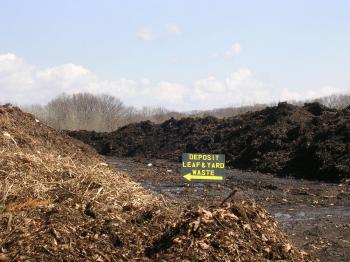 A small sign leads to the composting area at the Cape Elizabeth Transfer Station.
Send questions/comments to the editors.
