



Sixty years to the day after his ship was sunk by a German U-boat in Casco Bay, John P. Scagnelli stood in a long, tan trenchcoat under the picnic shelter at Fort Williams Park, with the three remaining survivors of the attack and 120 onlookers.
All four, Scagnelli, John L. Breeze, Joseph C. Priestas and Harold H. Petersen, wore navy blue hats with “USS Eagle, PE-56 survivor” written in gold on the front. The ceremony marked the placement of a memorial next to Portland Head Light honoring the men of the Eagle, a sub chaser sunk by a German torpedo just nine miles southeast of Portland Head on April 23, 1945.
“I never thought I’d see the day,” said Breeze, at 82 the youngest of the survivors. “Sixty years, I didn’t think I’d be alive.”
It was a cold, wet, windy day. A banner was tied up on the seaward side of the shelter to block the numbing wind as the friends and family members of the crewmen of the USS Eagle listened to Scagnelli, the only surviving officer, read off the names of the 49 crewmen lost and those survivors since deceased.
Breeze, a machinist on the Eagle, stood with his head bowed and rang a ship’s bell after each name.
It was silent except for the wind, the bell and Scagnelli’s voice repeating names of men he knew long ago. After the 58th name and 58 rings of the bell Scagnelli arrived at the names of those survivors still living. John Breeze stopped and turned away from the bell. “We don’t get the bell,” he said.
Everyone laughed and the mood lightened. Scagnelli read their four names, a prayer was said, a Navy color guard gave a 21-gun salute and a bugler played “Taps” at the approximate time that the torpedo hit.
Uncovering history
On the morning 60 years before, the USS Eagle left Portland Harbor towing a spar for aerial torpedo bombing practice. It was a clear, cold day with slightly choppy seas and unlimited visability. Following morning exercises the crew was waiting for another group of planes; some sat down for chow, some napped in their bunks, some were on watch.
What followed that afternoon was mislabeled for 60 years in official records, which attribited the ship’s sinking to a “boiler explosion.”
That is, until Paul Lawton, a naval historian from Massachusetts, stumbled onto the story of the Eagle during a conversation with a friend whose father died serving on the ship that day in 1945.
After the conversation and hearing about the possibility of a German U-boat in Casco Bay at the time, Lawton began combing through the records and became convinced the Navy had made a mistake.
At approximately 12:14 p.m. that afternoon in 1945 the Eagle was sitting at a dead stop in the water waiting for afternoon exercises. Suddenly, an explosion that was seen from Fort Williams nine miles away sent a spray of water 300 feet in the air and ripped the Eagle in half.
The stern section sank quickly, but more than a dozen survivors were able to jump clear of the sinking wreck. The severed bow, however, took longer to sink, first rising into the air until the section was perpendicular to the water and the large painted number “56” was clear. It took 12 to 17 minutes for the bow to go down, but during that time only one man, Engineering Officer Lt. John P. Scagnelli, was able to escape the wreckage.
Several Navy ships in the area at the time witnessed the explosion and raced to the scene to rescue what sailors they could from the 42-degree water: Of 62 officers and crewmen only two bodies and 13 survivors were recovered. The newspapers called them the “lucky thirteen.”
Following the incident many of the survivors reported seeing a German U-boat surface after the explosion. The Navy held a Court of Inquiry presided over by Capt. Ernest J. Freeman, who also was the commanding officer of the Portland Naval Station and ultimately responsible for the Eagle and its crew.
Despite the abundance of evidence that pointed towards a sub attack, the Court of Inquiry ruled that “the cause of the (accident) was the result of a boiler explosion, the cause of which could not be determined.”
Coincidentally, the Eagle had in 1942 rescued the survivors of the U.S.S. Jacob Jones II, the first U.S. warship sunk in American coastal waters by a German U-boat during World War II. The Eagle became the last such victim.
Forty-nine American officers and crewmen were lost that day, the worst U.S. Naval loss in New England waters during the war. Those who were not killed in the explosion drowned, were sucked down with the wreck or died from exposure to the cold before they could be rescued. Scagnelli believes many of the crewmen were knocked unconscious and trapped below decks as the ship sank to the bottom of the bay.
Righting a wrong
The sailors lost that day were dishonored by the apparent official cover-up, Scagnelli said.
As the only surviving officer from the Eagle, he was left with the responsibility of writing the letters to the families of the lost sailors. Scagnelli was told by the Navy to repeat the official findings of a “boiler explosion” as the cause of the sailors’ deaths. He was told not to mention a torpedo or a German U-boat. The writing of those letters has been a burden to Scagnelli ever since, said Lawton.
In 2001, Lawton persuaded the Navy to correct their erroneous records and list the sinking of the Eagle and the loss of its crew as a result of enemy action. Lawton said this was the first time the Navy had ever changed an incident from an accident to an attack. The change resulted in the awarding of 51 Purple Hearts, 49 of them posthumously.
“It means a closure to the matter of how the ship was sunk,” Scagnelli said, “and the fact was that it was sunk by enemy action.”
Scagnelli thanked the people present at the ceremony for coming, “because I know it means a great deal to you and the men that were lost. … God bless you and I hope you have peace and contentment in your hearts,” he said.
The memorial, which is at an observation post next to Portland Head Light, was entirely paid for with contributions from friends family members of victims and survivors of the explosion. So much money was raised that enough was left over to pay for a lunch buffet at DiMillo’s Floating Restaurant following the dedication.
Lawton and his team of underwater divers have not located the remains of the Eagle yet, but said they have not given up looking. They will be back when the weather gets better to search 15 square miles of Casco Bay.
 The survivors of the USS Eagle 56 and others. From the top left to right: Paul Lawton, Stephen Puleo (author of “Due to Enemy Action,” the story of the USS Eagle 56), Thomas Pendleton (a member of the PE-56 crew who was on leave for his wedding and wasn’t on board at the time of the tragedy); bottom row, left to right: John Breeze (survivor), Joseph Priestess (survivor), Harold Petersen (survivor) and Lt. John Scagnelli (the only surviving officer). The photo was taken by Robert I. Westerlund II, the grandson of Ivar A. Westerlund who was a casualty on the USS Eagle 56.
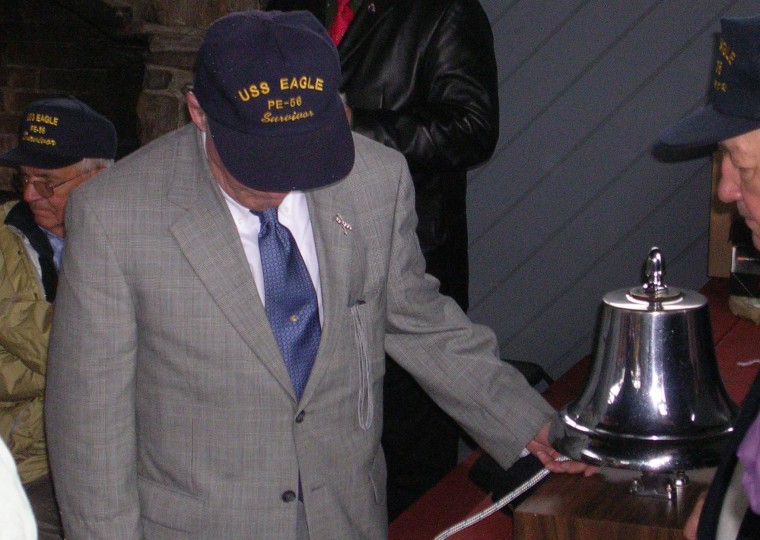 John Breeze rings the bell for each of his crew mates killed on April 23, 1945.
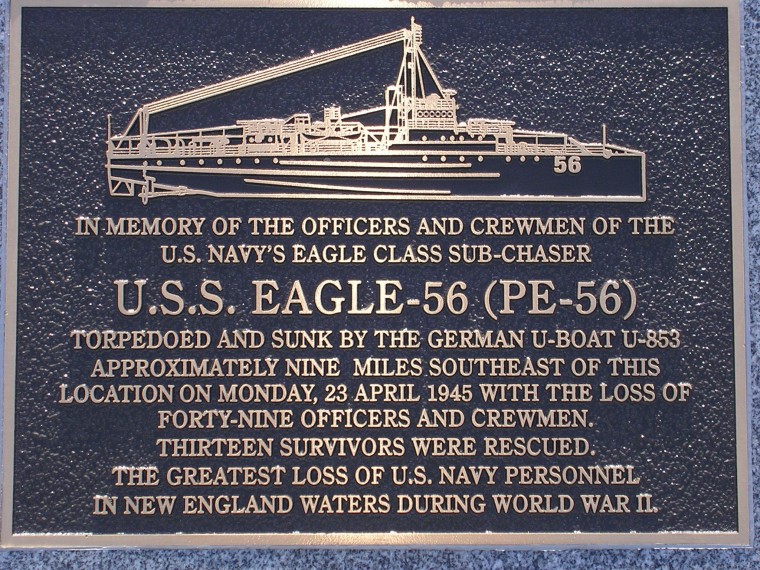 The memorial, placed at an observation point south of Portland Head Light, nine miles northwest of where the USS Eagle 56 was sunk by a German U-boat in 1945.
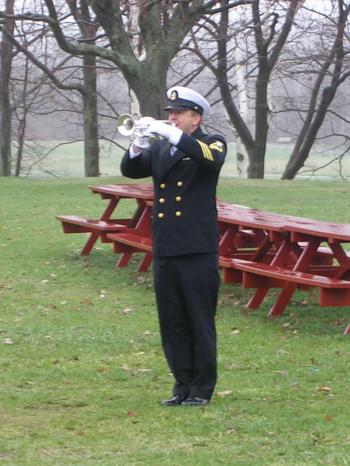 A Naval officer plays taps at the approximate time the USS Eagle was hit by a German torpedo in Casco Bay.
Send questions/comments to the editors.
