



The engineer and general contractor working on the Scarborough High School renovation and expansion both said they welcome a third-party review, but stand behind their work and believe that overall it is a quality project, sentiments supported by a state review of the work’s integrity.
The Town Council is considering hiring an outside engineer, at an estimated cost to taxpayers of $20,000, to review the project after Councilors Jeffrey Messer and Robert Patch raised a wide range of concerns regarding the quality of the project.
“We are happy to have any inspection of any kind at any time,” said Dan Cecil, principal of Harriman Associates, the project architect.
In fact, third parties have already been hired to review various aspects of the projects, said Joe Picoraro, project manager for Pizzagalli Construction.
And the state has submitted its report to the district based on a review conducted at the building last week by Dale Doughty of the Department of Education, and Goff French and Valerie Chiang of the Bureau of General Services. Also on the inspection were representatives of Harriman Associates, Justice and Scarborough High School Principal Andrew Dolloff.
The one major problem identified in the report was the fact that the exterior library wall is out of plumb. In the report, Doughty said the district has two options: the wall cold be removed and rebuilt or the town can claim a credit against the contractor. No decision has been reached.
But overall the inspection team did not find any serious problems in the building.
“It is my opinion that Scarborough school officials and their architect are very well informed and are taking the appropriate action to achieve a quality building,” Doughty writes in the report. “Had the site evaluation been conducted following the completion of the building, I believe that all of these items would have been corrected or confirmed to be structurally safe through engineering reviews.”
Firms defend quality
On Thursday night the construction management team for the $27 million project, including representatives from Harriman Associates, Pizzagalli Construction, the project’s Clerk of the Works Bob Poliquin, Owner’s Representative Norm Justice and several other consultants who worked on the project, met with the school board to discuss the issues.
Messer gave his presentation outlining some of the issues that have been identified to him, including mold, problems with anchor bolts, and quality of craftsmanship. All of the problems he found caused him to question the building’s structural integrity and potential for unexpected future maintenance costs.
Following the presentation, the construction team gave their response, addressing Messer’s concerns point by point and said that nearly every issue that Messer raised was handled and there are no serious structural or mold issues in the building.
The builders said many of the photographs used during Messer’s presentation showed just one moment in time and did not show the corrective measures taken to repair the issues.
Cecil said the photographs fall into three categories: issues that were corrected about a year ago, issues that have already been identified and are on a list of finishing touches, and issues involving the walls or roof, which have not had a final inspection.
“I don’t want the board to get the impression you are getting a lot of shoddy work because that’s just not the case,” Cecil said. Later he added, “You have received a skewed picture in my estimation.”
One area of contention is the roof. There have been pictures distributed showing a lot of material placed directly on the rubber roofing membrane, but the builders said much of it was on plywood atop the membrane.
In addition, the roof has not been accepted as finished, as Messer had claimed. In order for that to happen the manufacturer will have to inspect the membrane to ensure it is OK before issuing a warranty.
There also were photographs depicting wet roof insulation. The construction team said the tiles became wet when a storm blew apart the temporary protection. The damaged tiles have been replaced, they said.
A good portion of Messer’s presentation related to damaged anchor bolts and the fact that some were misplaced while others had a large number of washers holding them in place. Of the approximately 1,000 anchor bolts placed at the site about 4 percent have some problems, a number that the builders said they would like to see lower.
According to Keith Brenner, a structural engineer with Harriman Associates, anchor bolts are used to secure steel beams during erection and once the structure is put up do not have any effect on the building’s structural integrity. Once the structure is fully erected, the anchor bolts could be removed without causing any problems, he added. The bolts are required by the U.S. Occupational Health and Safety Administration.
Some of the photographs showed a few steel plates that had been torched, which, according to Brenner, will not affect the strength of steel.
“The new building we have designed is safe. There are no structural issues,” Brenner said. “I want the board and the citizens of Scarborough to be sure the building is safe and there are no structural issues out there.”
Mold was another big concern. According to a handout from the builders, of the 688,000 square feet of gypsum drywall in the project 10 square feet had mold on it and it was removed and replaced with new drywall. In addition, Northeast Test Consultants conducted indoor air quality tests that indicated everything was acceptable.
One of the more alarming photographs in Messer’s presentation showed the beginning stages of the loading dock wall that one portion of the wall out of line from the other two. This was part of the plan and while was a minor problem with the wall, it required no corrective action and the finished product looks straight.
Another issue that Messer raised was the footing forms being placed in water. There is a picture showing the wooden forms lying in a puddle and Messer inferred they were being installed while the ground was wet. But, according to Project Superintendent Bill Lawrence, the footings had been removed shortly after the picture was taken, the water removed, and then the footings again lay on dry ground. At no point was the footing put in water, he said.
Officials react
After the meeting Messer said there remain enough questions to warrant the $20,000 expenditure for the engineer. He said it is important to regain the public’s confidence in the project since the schools will be bringing another bond issue forward, maybe as early as 2006.
“There’s a lot of questions people have and they want to make sure it’s right and that’s what we want to do,” Messer said.
Messer said he did not agree with some of the explanations that were given during the meeting, while others raised more questions.
Patch said he still has some lingering questions and feels a third-party investigation is the best way to move. For example, the concerns that have been raised regarding the anchor bolts were not answered adequately, Patch said, He also was not satisfied with the explanation about the compaction rates of the roads around the high school.
“I still think we need an independent engineer to come in, look at the information and all of the documents and go from there,” Patch said. “At this point to me it would be better for everybody.”
School board members have varied opinions on whether or not the third-party engineer is necessary. Some remain in favor of the request, including board member Dianne Messer, who said the engineer was necessary for people’s piece of mind.
“I think there’s a lot of questions that are that are unanswered,” said Dianne Messer, who is Jeffrey Messer’s wife.
Also in favor of hiring the engineer is board member Bob Mitchell. While Mitchell feels there are no serious structural issues and was impressed with the builders’ presentation, he said it is necessary to finally put the concerns to rest and be able to move forward.
“If it takes one more (third-party review) let’s go get the thing so we can move on,” he said.
However, he is concerned about the type of report the town will get for $10,000 or $20,000 and said a thorough report may cost $30,000 to $40,000. In addition, a report may only cause delays in the project. But if the town does move forward with the engineer, Mitchell said the company should not have a relationship with any town officials.
Other board members felt that the explanation given by the builders was adequate and feel the expenditure is not necessary.
“I thought Mr. Messer’s presentation was very effective, but come to find out Pizzagalli has an answer for every one of his photographs,” said board member Walter Hansen. “Why go through an additional expense when it isn’t necessary.”
The Town Council gave preliminary approval to hiring the outside engineer at a meeting earlier this month, but wanted to wait for the school board to recommend the hiring before formally acting. The school board did not take any action on the issue during last week’s meeting, but will during its meeting on April 14.
The issue will then be on the Town Council’s agenda. The council could override any school board decision regarding the engineer, but Council Chairman Jeffrey Messer said he hopes it will be a collaborative project.
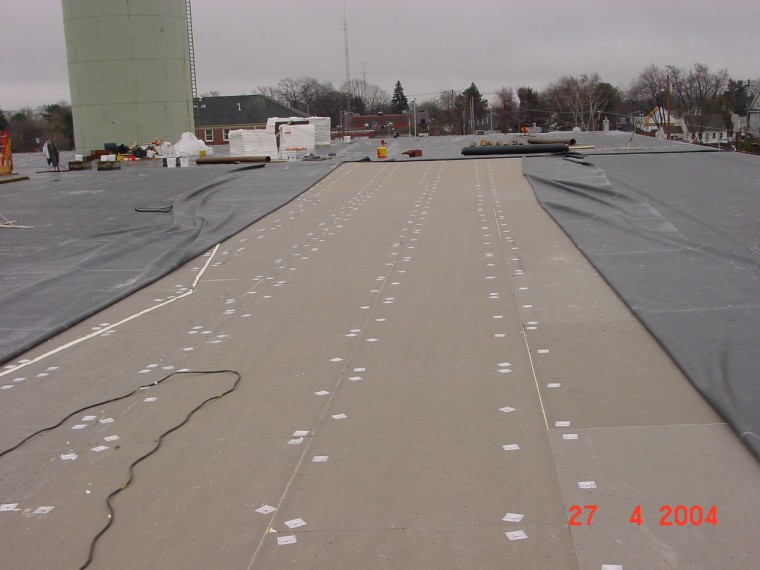 This photo shows the high school roof insulation, replaced after it was damaged by water in a storm. The high school project architect and builder say this and many other repairs have been made where problems existed.
Send questions/comments to the editors.
